

That gap is about to become expensive. The Rural Health Transformation Program (RHTP), a $50 billion federal investment in rural health infrastructure, is placing measurable outcomes at the center of program accountability. According to a national survey of 290 rural healthcare leaders commissioned by Julota and conducted by TrendCandy, 90% of rural healthcare leaders believe RHTP will raise the bar for proving measurable impact. Programs that cannot demonstrate cross-agency results risk being left behind in renewal decisions.
The good news is that the capabilities required to solve the proof problem are well-defined. To build them effectively, start by understanding the specific funding and policy requirements your organization must meet, which will guide your RHTP data infrastructure development.
What Capabilities Must Rural Healthcare Leaders Build for RHTP?
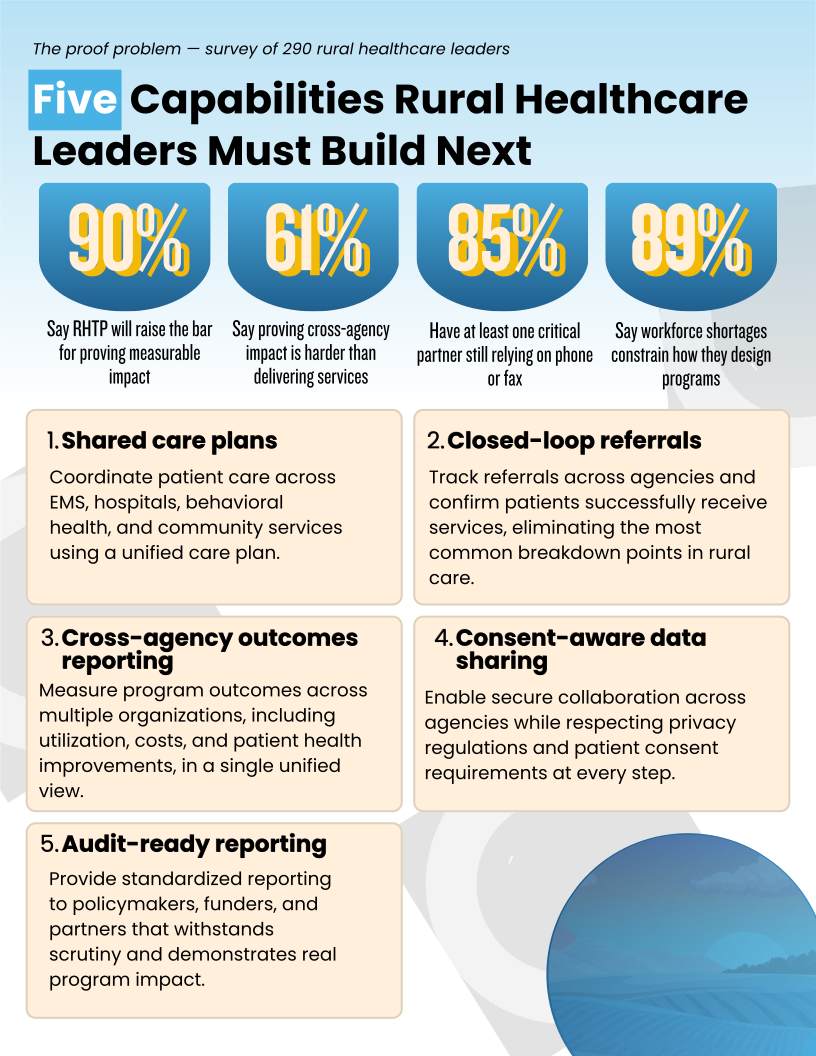
Rural healthcare leaders must build five capabilities to get the most from the Rural Health Transformation Program: shared care plans, closed-loop referrals, cross-agency outcomes reporting, consent-aware data sharing, and audit-ready reporting. RHTP is a 50 billion dollar federal investment that puts measurable outcomes at the center of funding, and the data infrastructure to prove impact is scattered across disconnected systems that still rely on phone calls and faxes.
Key Takeaways
- Rural healthcare transformation has a proof problem, not a care-delivery problem.
- RHTP makes measurable outcomes the condition of funding.
- Shared care plans and closed-loop referrals are the first two capabilities to build.
- Audit-ready reporting is what turns program work into fundable evidence.
Why Is RHTP Data Infrastructure a Structural Problem?
Rural healthcare organizations have historically operated in silos, with EMS, hospitals, behavioral health providers, and social services each using different data systems and formats. ONC data from 2023 confirm that lower-resourced hospitals, including small and rural facilities, engage less frequently in interoperable data exchange than their larger counterparts. Many rural organizations still rely on fax or mail to share patient information across agencies.
The Julota survey puts the operational cost of that fragmentation in stark terms. Sixty-one percent of rural healthcare leaders say proving cross-agency impact is more difficult than delivering services themselves. Leadership teams spend valuable hours assembling spreadsheets, chasing partner reports, and manually reconciling data that should flow automatically. Workforce is already stretched thin — 89% of respondents say provider shortages constrain how they design and scale transformation programs — and every hour spent on manual data reconciliation is an hour not spent on patient care.
“Rural healthcare transformation will not rise or fall on care delivery alone. It will rise or fall on whether organizations can prove impact across agencies.”
— The Proof Problem, Julota / TrendCandy, 2025
Building the five capabilities below does not require replacing every existing system. It requires connecting them through shared RHTP data infrastructure — a common environment where multiple organizations coordinate care and track outcomes together. This approach can inspire hope and a sense of possibility for rural healthcare leaders committed to transformation.
Capability 1: Shared Care Plans
What is it?
A single unified care plan accessible to EMS, hospital staff, behavioral health clinicians, and community services, simultaneously updated in real time as patients move across the care continuum.
How to build it:
Start by mapping every agency touching your highest-utilization patients. Identify the three to five data points each agency needs to see from the others to do their job well. Work backward from those needs to define a minimum viable shared care plan, not a comprehensive EHR, but a living coordination document that travels with the patient. Prioritize agencies that currently communicate only by phone or fax; those relationships represent your biggest coordination gaps. Pilot with two or three partners before scaling, and build in a governance agreement that clarifies who can update the plan and under what conditions.
Capability 2: Closed-Loop Referrals
What is it?
A referral tracking system that confirms, not just initiates, that patients successfully receive recommended services, eliminating the most common breakdown points in rural care transitions.
How to build it:
The survey found that 85% of rural programs have at least one critical partner still relying on manual communication methods. Manual referrals cannot close the loop because there is no mechanism to confirm completion. Begin by auditing your top three referral pathways — specialty care, behavioral health, and substance use treatment are the most common breakdown points identified in the research. For each, identify the moment of confirmation failure: is it at handoff, during scheduling, or after the appointment? Then implement a shared tracking layer that sends automated status updates back to the referring organization. Even a lightweight digital handoff form is a step forward from a fax that disappears into an inbox.
Capability 3: Cross-Agency Outcomes Reporting
What is it?
A unified reporting view that measures program outcomes — utilization, cost, and patient health improvements — across all partner organizations, not just within a single agency’s data silo.
How to build it:
Cross-agency outcomes reporting is the capability that directly addresses the proof problem. Without it, programs may be generating real value — avoiding emergency visits, reduced EMS runs, fewer behavioral health crises — but have no way to demonstrate it to funders. Start by agreeing on three to five shared outcome metrics with your primary partners before you build any reporting infrastructure. Common denominators across agencies tend to be ED utilization rates, referral completion rates, and 30-day readmission rates. Once metrics are agreed upon, work backward to identify which data sources feed each metric and what integration is required. Research on rural HIT adoption underscores that strengthening shared networks and standardizing data exchange across systems is the most effective lever for closing the evidence gap.
Capability 4: Consent-Aware Data Sharing
What it is:
A privacy-preserving framework that enables secure collaboration across agencies while honoring patient consent requirements and regulatory obligations at every step.
How to build it:
Consent-aware data sharing is often what stalls cross-agency coordination before it starts. Behavioral health and substance use data are subject to additional federal protections under 42 CFR Part 2, which requires explicit patient consent before disclosure to other providers. Rather than treating consent as a barrier, treat it as a workflow. Build consent collection into the first patient encounter — not as a separate administrative step, but as part of the care coordination conversation. Use digital consent tools that automatically timestamp, store, and surface consent status, so frontline staff never have to guess whether they can share information. Engage your legal and compliance teams early, but do not let perfect be the enemy of progress: a documented, auditable consent process is preferable to informal data-sharing arrangements that may expose the organization to regulatory risk.
Capability 5: Audit-Ready Reporting
What is it?
Standardized, exportable reporting that meets the documentation expectations of policymakers, CMS, and funders, and can withstand scrutiny without requiring manual assembly each reporting cycle.
How to build it:
Under RHTP, state applications must describe detailed metrics and evaluation plans, and programs will be evaluated on the clarity and completeness of their outcome reporting. That means ad hoc reporting assembled from spreadsheets will not be sufficient. Build your audit-ready reporting infrastructure now, before the first reporting deadline arrives. Work with your data team to create report templates that map directly to the performance measures in your RHTP application. Automate data pulls wherever possible so reports reflect current program performance rather than a manual snapshot. Store documentation of data sources, methodology, and any limitations so auditors and funders can trace every number back to its origin.
Where Should Rural Healthcare Leaders Start?
Building five new capabilities simultaneously is not realistic for organizations already stretched by workforce shortages. The survey data suggests a sequencing logic: start with closed-loop referrals, because referral breakdown is both the most common failure point and the most visible to partner agencies. Demonstrate that one capability is visibly working, and the case for shared RHTP data infrastructure becomes easier to make across the organization and with funders.
From there, shared care plans and cross-agency outcomes reporting can be layered in, with consent-aware data sharing and audit-ready reporting built in parallel as the infrastructure matures. The communities that succeed under RHTP will be those that treat RHTP data infrastructure not as an IT project but as a strategic capability — as fundamental to their transformation program as the clinical services they deliver.
The proof problem is solvable. But it requires building the systems to solve it before the accountability clock starts running.
Read the full research report: The Proof Problem — Why Rural Healthcare Transformation Will Rise or Fall on Data Infrastructure, commissioned by Julota and conducted by TrendCandy. Insights from 290 rural healthcare leaders on sustainability, workforce pressures, and cross-agency coordination.