The Problem: Interoperability Barriers in Healthcare, Behavioral Health, and Emergency Response
Data Systems

Data systems used in healthcare, EMS, behavioural health, and law enforcement often can’t share information. They are specialty applications developed independently of one another, designed by individual vendors to meet the specific needs of their industry.

But it has become clear that these institutions serve many of the same community members—and all of them would be more efficient if they could share data.

Julota’s Makes Health Data Interoperability Possible

Many healthcare organizations can’t exchange health data with one another, let alone EMS or other community agencies. Julota bridges the gap between healthcare organizations that use different EHR (electronic health record) systems, and between EHRs and EMS ePCR (electronic patient care reporting) systems.

For example, accountable care organizations often work with organizations across a whole community to improve health outcomes for their members. But interoperable data systems are needed if the care coordinator is to effectively track whether a member received the medical and non-medical services they needed after a hospital discharge, an opioid overdose, a visit to the emergency room or other event.

Or, EMS may receive repeated calls to help the same older couple with lift assists but may not be able to communicate with the couple’s doctors or anyone else to get them the support they need to live independently.

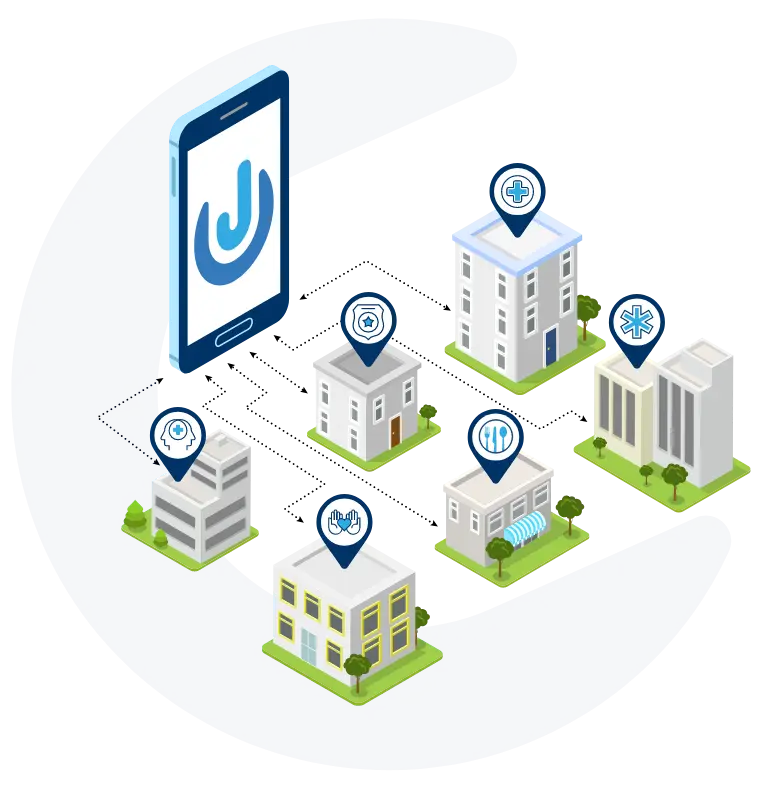
Julota’s platform can connect these different systems and make communication and data sharing possible.

Julota Enables Interoperability Of Public Safety Data For Coordinated Response

Julota helps to connect EMS, law enforcement and healthcare for more coordinated responses to everything from mental health crisis intervention to disaster response. With a shared, cloud-based data platform, Julota facilitates communication of crisis intervention teams (CIT) and the partnerships between law enforcement and behavioural health providers.

Perhaps a person has a mental health treatment plan but does not have the transportation to get to appointments or access needed prescriptions. Maybe a formerly incarcerated person is back in the community and no longer has access to healthcare, behavioural health services and needed medication.

Julota helps a range of agencies and organizations to connect so community members get what they need and law enforcement/emergency services can tap into the resources of the community to assist those with complex needs.

Establishing interoperability via SaaS ensures that EMS can communicate quickly with law enforcement and behavioural health professionals. Members of the team can connect the person to needed healthcare, behavioural health and non-medical services, such as housing.

Service is the Key to Software as a Service (SaaS): Julota Works Hard to Make Interoperability Work for You

Julota’s platform uses cloud computing technology to offer software as a service, or SaaS, to communities to help them connect better and make their systems interoperable. We are committed to working with you to make sure you get what you need from this solution, and that it opens up opportunities for your community to work together more efficiently.

We listen carefully to the needs of our clients and work collaboratively with them to solve problems and maximize the use of this tool. Our goal is to make it as easy as possible for you and your staff to use the platform while maintaining the highest standards of data security and privacy.

Team members can use their own laptop, tablet or smartphone while out in the field to access the platform over the internet. It doesn’t really matter what operating system runs on the phone since the platform is accessible in a browser with no need for a special app.

At Julota, we are proud of the interoperability platform we’ve developed to store an organization’s data in the cloud. Keeping the community connected through this software as a service means organizations can save money and work more efficiently together to safeguard the public. If you and other stakeholders in your organization are interested in finding out more about the Julota platform’s capabilities and how to integrate the system with your own computer setup, please connect
with us today.

Interoperability Platform FAQs

What does interoperability mean for community health and public safety agencies?

Interoperability means the separate systems that hospitals, EMS, law enforcement, behavioral health, and social services each run can exchange information so the people working a shared case see one record. Without it, the same person is documented five times in five systems and nobody sees the whole picture.

Julota connects electronic health records (EHR), EMS electronic patient care reporting (ePCR), law enforcement computer-aided dispatch (CAD) and records management systems (RMS), homeless management information systems (HMIS), and behavioral health and social service case management tools. Partners keep their systems and Julota links the data and the workflow between them.

No. Julota is a coordination layer that sits alongside the systems of record your agencies already use. Clinicians keep charting in the EHR, medics in the ePCR, and dispatch in CAD; Julota is where the shared referrals, care plans, tasks, and outcomes live.

Sharing is consent-based and permission-based. Each partner sees only what their role allows, and the platform is built to comply with HIPAA, 42 CFR Part 2 for substance use treatment records, and CJIS for law enforcement data.

EMS and mobile integrated health teams, hospitals and emergency departments, law enforcement co-responder and diversion programs, behavioral health providers, public health departments, social service agencies, and community-based organizations that respond to the same high-need residents.

No. Julota runs in a web browser on the laptop, tablet, or smartphone your team already carries, on any operating system. There is no server to maintain and no special app to install.

When every responder can see prior contacts, active care plans, and open referrals, repeat callers are recognized, follow-up is assigned instead of assumed, and the person is connected to the service that addresses the underlying need. Fewer unnecessary transports and ED visits follow from that.

An HIE moves clinical documents between healthcare organizations. Julota coordinates the work across sectors, including partners that are not healthcare providers, with shared referrals, tasks, notes, alerts, and outcome reporting on top of the data exchange.

It depends on the scope of the program, but plan on a minimum 12-week build, and longer for more advanced projects. Julota is cloud-based with no hardware to procure. The build covers configuring your fields and workflows, connecting the systems and partners involved with the right permissions, and training the team.

Here's What Our Excellent Clients Say...

Get In Touch

We would be delighted to show you a demo, put you in touch with current customers, and answer any questions you have. Reach out anytime.