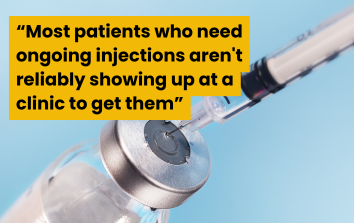
But the coverage isn’t unconditional. It runs out on a schedule, and when a patient misses that window, the consequences aren’t gradual. They can be immediate, and for naltrexone specifically, they can be fatal.
MIH-CP programs are already in these patients’ homes for other reasons. This is a case for why the injection window itself should be on their radar.
What Happens When a Patient Misses Their Vivitrol or Sublocade Shot?
For Vivitrol, a missed dose means a documented overdose risk. The FDA’s own labeling states that after a missed dose or discontinuation of naltrexone, “cases of opioid overdose with fatal outcomes have been reported.” That happens because the blockade that suppressed the patient’s opioid tolerance is gone, but their memory of their old dose isn’t. A dose that used to feel normal can now be fatal. SAMHSA repeats this warning on its own patient-facing naltrexone page, which tells you how seriously the field takes it.
Sublocade’s failure mode looks different. Buprenorphine is a partial opioid agonist, so a missed dose is less likely to trigger the same acute overdose mechanism as naltrexone. What it does trigger is a slower slide: withdrawal symptoms return, cravings return, and the protective effect that was holding a patient in recovery erodes.
The RECOVER study, which followed 529 people on Sublocade for 18 months, found that patients who’d already built up 12 or more months of consistent treatment sustained abstinence 72-88% of the time. Patients without that runway sustained it at a much lower rate, 47% overall across the full study population. Continuity, more than the drug itself, is doing most of the work here.
The two medications fail in different ways, but they lead to the same conclusion: the injection date matters as much as the injection itself.
Why the Injection Window Is Where OUD Treatment Breaks Down
The patients most likely to miss that window are those with the least reliable way to get there. Rural residents face this hardest. According to the Rural Health Information Hub, 18% of people in larger rural areas and 40% in small or isolated rural areas live more than 30 minutes from the nearest mental health facility, compared with under 10% in urban areas.
Layer a workforce shortage on top of that distance problem: HRSA’s 2025 Behavioral Health Workforce Brief found that as of September 2024, nearly 62% of federally designated Mental Health Professional Shortage Areas are rural.
Put those two together, and you get a patient who needs a ride, a clinic slot, and a provider, all lining up on the same day, every 28 to 56 days, indefinitely. Miss any one piece and the appointment slips. For most medications, a slipped appointment means catching up next week. For an OUD injectable, it can mean the difference between staying in recovery and a preventable overdose.
A Home-Visit Model Already Proved the Concept
This isn’t a hypothetical fix. A 2024 pilot at a rural Indian Health Service site had outreach pharmacists administer long-acting injectable medications directly in patients’ homes when they couldn’t get to the clinic. It’s worth being precise about what this pilot covered: it was long-acting injectable antipsychotic medication for serious mental illness, not an OUD medication.
But the mechanism it tested is exactly the one this piece is arguing for. Adherence, measured as proportion of days covered, rose from 26% to 67%. Behavioral health ER visits for the pilot group dropped from 11 to 2.
The real lesson is that bringing the injection to the patient, instead of requiring the patient to reach the injection, closes an adherence gap that clinic-based scheduling can’t close on its own. Whether pharmacists should extend that model to OUD medications is a reasonable next question. Either way, it’s a model MIH-CP programs are structurally built to run.
Where MIH-CP Programs Are Positioned to Step In
Community paramedicine already has a track record of preventing exactly the downstream costs this gap creates. One HFMA case study documented a program saving roughly $6 million a year by preventing an ED visit or admission 82% of the time it intervened.
A separate peer-reviewed study of a geriatric community paramedicine program found a 40.9% reduction in hospital admissions and more than $410,000 in savings across the study cohort. Programs are already proving they can keep patients out of the ER through home-based intervention. An OUD injectable support track is a natural extension of work MIH-CP teams are already doing, not a new mission.
The honest caveat: scope of practice for administering injectable medications varies by state, and in most jurisdictions it isn’t settled. A decade ago, a JEMS survey of state EMS offices found only a handful had expanded community paramedic scope beyond standard paramedic authority at all, and that was for tasks like suturing, not injectable medication administration.
That landscape has likely shifted since, but it shifts state by state, not all at once. Any program considering this needs to start with its own state EMS office and medical director, rather than assuming the authority already exists.
What It Takes to Pilot an OUD Injectable Support Track
Programs that want to test this don’t need to solve the scope of practice everywhere at once. They need to prove the concept in one place first. A few starting points:
- Start with care coordination, not administration. Before a program touches the scope-of-practice question, it can build the simpler version: using home visits to confirm injection dates, arrange transportation, and flag patients approaching the end of their coverage window before they miss it.
- Track proportion of days covered. This is the same metric the rural pharmacist pilot used, and it’s the one payers and grant reviewers already understand.
- Track overdose events and ED visits avoided, not just adherence. Adherence is the mechanism. Fewer overdoses and fewer ER visits are the outcome that justifies the program.
- Loop in the medical director and state EMS office early on what’s actually permitted, and build the pilot around that answer rather than around what the program hopes is permitted.
None of this requires waiting for a national policy shift. It requires one program willing to run the pilot and document what happens, just as the rural IHS site did.