Mobile Integrated Health-Community Paramedicine (MIH-CP) teams work with law enforcement to screen and respond to people who fit the criteria for jail diversion. These teams will intervene to prevent arrest and incarceration of those with low-level offenses and help them find real freedom via solutions that address their root issue. Sometimes, these programs redirect people toward drug rehab, mental health care, or close coordination with social workers.
The goal is to listen to each individual story and figure out what they really need to thrive.
How Community Paramedicine Jail Diversion Works with LEAD
MIH-CP teams work with law enforcement to help prevent unnecessary arrests and to redirect people from jail toward lasting health and freedom. But how do these programs work? Are they really making a difference? We’ll talk about all of it as we go on.
The general premise of the LEAD program is to divert people from jail and toward care that will actually address their condition and related behavior. Of course, these programs typically focus on low-level, nonviolent offenses.
To provide an example, consider the person who is homeless and has been picked up by the police and eventually arrested for repeated loitering. This is one of those instances where it should be obvious that arresting the person for loitering, releasing them, and then rearresting them when they inevitably commit the infraction again is a useless endeavor.
LEAD programs believe it would be much better to divert that person away from jail and toward a social worker who can help them find stable housing and begin to unravel the tangles in their life that hold them back.
We used homelessness as an example, but the same logic applies to countless other conditions. The person with untreated behavioral health issues is arrested repeatedly for disorderly conduct. The person with substance use disorder is arrested for possession. In each scenario, jail only makes the underlying condition worse.
Here’s how MIH-CP can partner with LEAD programs on community paramedicine jail diversion:
- Implementing Trained Co-Responder Teams
- Reaching out to People with Substance Use Disorder
- Helping People with Mental Health Struggles
- Assisting Those in Unstable Housing Conditions
- Connecting Incarcerated Individuals with Care
- Building a Collaborative Community for Jail Diversion
Every LEAD program will look a little different based on the community, so let’s have a look at some of the smaller details related to each of these points.
MIH-CP and LEAD: Implementing Co-Responder Teams
Law Enforcement Assisted Diversion programs don’t have to wait until after the arrest to act. While some jail-diversion programs evaluate cases after a person has been taken into custody, more police officers make decisions when they first contact someone.
How does this work? Imagine a police officer is called out for disorderly conduct. Perhaps someone is yelling and behaving abnormally in a restaurant. A typical response would be for police officers to contact the person, explain that they need to change their behavior, and then arrest them if they don’t.
A LEAD approach would handle it somewhat differently. These teams may implement a co-responder team, where law enforcement officers work directly with behavioral health professionals to contact the patient. This co-responder team still focuses on bystander safety, but it also focuses on de-escalating and determining whether a medical condition may be causing the person’s erratic behavior.
The co-responder team may still need to carefully restrain the patient to protect themselves and others, but transport often ends at a hospital for further care.
L.E.A.D vs. LEAD Programs: Reaching out to People with Substance Use Disorder
Another way that LEAD programs help prevent unneeded jail time is by reaching out to those people who have substance use disorders. Before we talk about the specifics of this, we need to address the difference between a L.E.A.D. program and the LEAD programs we’re discussing in this article.
When you add those three little dots (L.E.A.D.), you get Law Enforcement Against Drugs and Violence. These programs are mainly comprised of police officers working with youth to prevent the negative impact of substance use disorder in schools and communities around the country.
On the other hand, LEAD programs (Law Enforcement Assisted Diversion) are designed to break the jail-and-release loop. In some cases, you may see these names used interchangeably. Sometimes these two programs can overlap.
Imagine you have a community where substance use disorder and related overdose deaths are of top priority. In these instances, LEAD and L.E.A.D. programs can operate with a two-pronged approach.
L.E.A.D. teams focus on stopping the problem before it starts by raising awareness and educating youth. LEAD teams can help redirect people caught in perpetual SUD by moving them away from jail cells and toward real healthcare.
So, even though these names are similar (and the programs might overlap from time to time), these are different initiatives with differing approaches to a similar problem.
Using LEAD to Help People with Mental Health Struggles
There are instances where people with mental health disorders will have events that escalate to the point of a crime. LEAD takes a common-sense stance on the issue. The goal isn’t “get people out of jail”; it’s to get people real help for the illnesses that plague them.
For someone with a mental health disorder, it’s very easy for a behavioral crisis to look like a crime. LEAD teams try to take a more nuanced approach. If someone is having a behavioral event, they first ensure that they are safe. Then, they work to figure out whether the patient had a trigger for the event.
Finally, they work toward a resolution, usually by taking the patient to a hospital or coordinating treatment with mental health professionals.
LEAD Teams and MIH: Assisting Those in Unstable Housing Conditions
MIH teams can work with LEAD programs to help people who are homeless or have unstable housing. If someone is sleeping in their car or trying to rest on a city bench, will putting them in jail really correct the issue? The answer is a resounding no.
An MIH team practicing LEAD principles may partner with a social worker. When they encounter someone who has nowhere safe to sleep, the social worker can help coordinate a better arrangement, avoiding jail altogether.
LEAD and MIH: Connecting Incarcerated Individuals with Care
So far, we’ve talked mostly about preventing people from being unnecessarily jailed. But what about those people who find themselves already trapped inside a prison? In these cases, LEAD programs and principles can also be applied. Especially when that person is finally transitioning out of jail and into regular life.
At this critical juncture, MIH teams can reach out to the individual, provide positive resources, and help break the loop before it has a chance to strike again. In addition, these programs can help people before they are released by providing evaluations and coordinating with prison health officials.
Building a Community Paramedicine Jail Diversion Network with Law Enforcement
When the community works together, its capacity to do good increases greatly. Yes, a single organization can have an impact, but this effect can grow exponentially when others are closely involved.
In the case of LEAD, it makes sense to have more than just EMS and law enforcement involved. Communities should also bring physicians, ERs, and rehab facilities into the loop. The goal is a close interconnectedness that ensures people who need help are quickly and efficiently connected with the right provider.
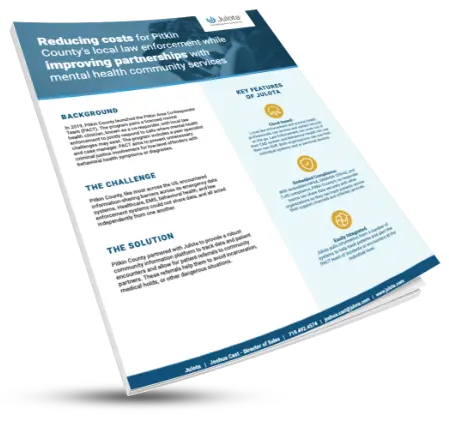
Using tools like Julota’s advanced software platform can help you build this connectedness. Julota acts like a central hub, where providers can safely share information across platforms. This enables better care coordination and seamless collaboration across the community.
Key Takeaway: Building a Community Paramedicine Jail Diversion Partnership with LEAD
LEAD is a model more than it’s a physical organization. Any community around the country can practice the principles LEAD lays out. Among community champions for jail diversion, Mobile Integrated Healthcare ranks at the top.
Through community paramedicine jail diversion, MIH-CP teams can work with law enforcement to help screen individuals who may be eligible for alternative transport that doesn’t involve arrest. These teams reach out to those with mental health struggles, substance use disorders, and complex social issues to prevent jail time and combat the core of their situation.
Contact Julota for more information on how their tools can help your community build an integrated LEAD program. A representative would be more than happy to listen to your unique situation and answer any questions.