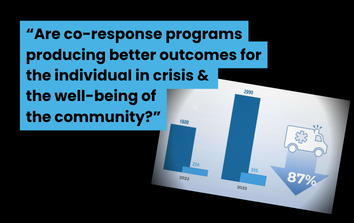

Are co-response programs producing better outcomes for the individual in crisis and the well-being of the community?
The impact of crisis response ultimately measures a program’s success, and a thorough evaluation plan is critical for monitoring crisis response interventions and their outcomes.
Without an evaluation plan, it is difficult to determine whether co-response programs are reducing future crises, decreasing arrest rates and hospital visits, increasing referrals, or improving safety. A clear evaluation plan provides evidence of what is working and what areas of improvement need to be addressed.
Call volumes and response times do not indicate whether harm was reduced, stabilization occurred, or safety changed because they are just metrics. It is important to evaluate both program activity and outcomes, prioritizing the latter over data.
How Do You Evaluate a Co-Response Program?
You evaluate a co-response program by measuring what matters rather than routine metrics: safety outcomes, diversion from emergency systems, and community experience and satisfaction, plus equity and access across the people served. Call volumes and response times do not show whether harm was reduced or stabilization occurred. A practical evaluation framework, ethical data collection, and a habit of using results to strengthen the next response make the plan work.
Key Takeaways
- Without an evaluation plan, nobody can say whether the program reduces crises, arrests, or hospital visits.
- Safety, diversion, and community experience are the three outcome families.
- Equity and access must be evaluated, not assumed.
- Evaluation exists to improve the next response, not to file a report.
Why Does Co-Response Evaluation Matter?
Questions to consider for an evaluation plan to support a program’s growth and accountability include:
- Are crisis outcomes improving?
- Are people receiving appropriate care?
- Are responders safer?
- Is the community benefiting from the program?
- Are resources being used effectively?
Effective evaluations matter because individual stories and data together do not reveal broader trends or gaps in service. Programs may also face early challenges, but continuous and thorough evaluations can provide details on what was successful and what needs to change.
How Do You Move Beyond Routine Metrics?
Operational numbers that are commonly focused on by co-response teams include:
- Rate of calls
- Actual arrest rates
- Transport statistics
- Real-time response times
- Hospital admissions
While these numbers are important, they offer limited insight into the impact of interventions and individual success.
Effective evaluation plans should not rely solely on important metrics, as they do not indicate successful crisis intervention outcomes. For example, a crisis response may seem successful in reducing arrest rates or response times. Still, if support and follow-up care are not included, the evaluation plan will not be successful overall. A successful evaluation plan looks beyond operational performance to ensure that interventions achieve the best possible outcomes for the individual and the community.
1. Safety Outcomes
Safety continues to be a fundamental priority, and the evaluation should consider:
- Amount of use of force
- Injuries
- Escalation or de-escalation patterns
- Scene safety
Behavioral health crises have the potential for escalation, injury, or further trauma, and data regarding safety show immediate outcomes of crisis intervention. When the evaluation goes further and shows reductions in the use of force, fewer injuries, and successful de-escalation, it provides evidence that co-response teams help stabilize crises.
2. Diversion From Emergency Systems
Co-response programs seek alternative interventions to minimize involvement of emergency departments and the criminal justice system.
The evaluation may track:
- Jail diversion rates
- Emergency department diversion
- Psychiatric hospitalization rates
- Repeat emergency utilization
- Referral completion
Diversion also ensures that responders are matching individuals with the appropriate level of care. An effective crisis response is about helping individuals access resources to avoid similar crises in the future. Evaluation helps determine whether diversion efforts are creating meaningful pathways to treatment rather than moving individuals between various systems.
3. Community Experience and Satisfaction
A frequently overlooked aspect of an evaluation is obtaining direct feedback from those receiving services.
Community feedback offers insight that data alone cannot provide.
Programs may evaluate:
- Respect and dignity
- Satisfaction with the services provided
- Trust in responders
- Willingness to seek or ask for help again
Surveys, interviews, and community listening sessions produce valuable information for evaluations. When individuals are listened to and respected, engagement improves, which in turn influences more successful outcomes.
How Do You Evaluate Equity and Access in Co-Response?
An effective co-response evaluation plan should examine whether services are effective and if they are reaching all populations equally. Strong overall outcomes can mask disparities in access, engagement, and results among diverse groups, making equity an essential component of a co-response evaluation plan.
Factors such as geography, culture, language, socioeconomic status, disability, prior arrests, and hospitalizations can influence both access to services, interventions, and crisis outcomes.
Evaluation efforts should assess:
- Rural versus urban access
- Cultural responsiveness
- Language accessibility and communication barriers
- Demographic disparities
- Service gaps among at-risk populations
- High versus low crime communities
Rather than focusing solely on overall program performance, agencies should analyze outcomes across different populations to identify patterns that may otherwise go unnoticed. Differences in response times, service utilization, referral completion, repeat crisis involvement, or long-term outcomes may indicate barriers that require attention. A strong evaluation plan should include monitoring equity to ensure fair and effective crisis responses by identifying areas for improvement and ensuring that communities with the greatest needs are served with the same diligence as other communities.
Beyond these examples of structural barriers, it is important to note how individuals experience the crisis response process. If an individual has negative associations from past experiences with emergency rooms, law enforcement, or behavioral health referrals, they will be less likely to engage with available services.
Other barriers that could influence equity and access include an individual’s transportation limitations, access to technology, and insurance coverage. This can influence the ability to receive ongoing support after the co-response team intervenes.
By evaluating both system-level barriers and individual experiences, co-response programs can gain a more complete understanding of access and equity challenges through evaluations and develop targeted strategies to improve service delivery for underserved populations.
How Do You Build a Practical Co-Response Evaluation Framework?
Prioritizing data collection can sometimes create unnecessary barriers, overwhelm staff, and consume resources while yielding limited usable insights. The value of evaluation is not solely based on data but on information that supports the intervention outcome. To avoid barriers, a framework should identify the specific outcome the program is trying to achieve and provide a clear picture of what success will look like.
There are several foundational questions on how progress can be measured that can help guide this process:
- What are we trying to accomplish?
- How will we measure success?
- Who will collect, analyze, and review the data?
- How will findings be used to improve practice?
A focal point of the evaluation efforts should not be metrics or activities but rather successful outcomes. Metrics should align directly with program goals so that collected data provides meaningful insight into performance and opportunities for improvement.
When agencies establish measurable goals from the outset, they are more likely to evaluate program strengths, recognize rising challenges, and make data-informed adjustments.
Developing and maintaining an evaluation framework should be a collaborative effort. Co-response programs operate at the intersection of public safety, behavioral health, emergency response, and community services, making a broad perspective essential for meaningful evaluation.
Developing and maintaining an evaluation framework should be a collaborative effort among co-response teams. Diverse perspectives strengthen interpretation and help ensure that findings are translated into meaningful improvements in policy, training, resource allocation, and service delivery to properly address crisis interventions.
A practical evaluation framework delivers a guide for understanding program performance. By formulating clear objectives, selecting meaningful measures, and consulting stakeholders in the co-response team throughout the process, communities can create evaluation systems that generate useful information, support continuous improvement, and demonstrate the true impact of co-response programs.
Data Collection and Ethical Commitment
Collecting crisis data also entails paying attention to the ethical duties involved.
Behavioral health information is highly sensitive, and evaluation processes must protect confidentiality and privacy, which includes:
- Secure data systems
- HIPAA compliance
- Open reporting
- Consent considerations
- Clear data-sharing
When handling crisis data, it is important not to misinterpret numbers, as this can cause harm and oversimplify human suffering. The purpose of the evaluation is not to assign blame or reduce individuals to statistics, but to guide and monitor improvements in care. A co-response evaluation plan focuses on: what happened, why it happened, and what can be improved.
Using Evaluation to Strengthen Future Crisis Responses
The ultimate evaluation is not found in reports or dashboards but lies in strengthening future crisis responses. Every evaluation finding delivers an opportunity to improve co-response and crisis interventions.
For example, agencies may find that improvements are needed in future responses when certain populations have longer response times, low referral rates, or when certain intervention techniques work better than others.
Evaluations are ever-growing and function as a tool for ongoing quality improvement by continuously assessing performance, accommodating changing community needs, and strengthening co-response teams.
Conclusion
Ultimately, the purpose of a co-response evaluation plan is to determine whether crisis response efforts are achieving their anticipated outcomes. Communities invest in co-response programs because they believe collaborative interventions can produce safer, more compassionate, and more effective responses to behavioral health crises. Evaluation provides the evidence needed to test that assumption, strengthen accountability, and direct future improvements. When done well, evaluation ensures that crisis response is not only immediate and effective but also continually improving for the individuals, families, and communities it serves.