David A. Porter, MA, LADC.
April 22, 2026
Co-Responder Program Outcomes in Schenectady

Since the 1980s, the city has declined. GE moved nearly its entire operation overseas, which resulted in high unemployment and economic hardship in Schenectady. ALCO closed down. Schenectady has since suffered increased crime, addiction, and homelessness. Measures have been put in place to mitigate harm and reverse these trends, including a co-responder program.
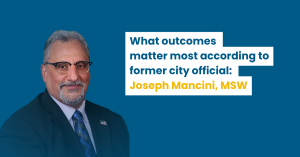
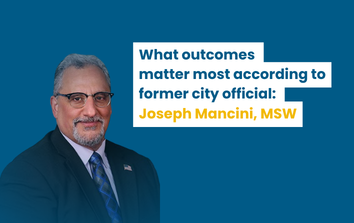
I interviewed Joseph Mancini, MSW, a former city councilman of Schenectady, NY. In addition to his many other roles in the juvenile justice system, Joseph developed a co-responder program in Schenectady. As someone who has a broad perspective on the issues, Joseph and I discussed the details of the program he pioneered and led, with a particular focus on co-responder program outcomes that city administrators can measure and replicate.
DAP: Good morning, Joseph. Can you tell my readers a bit about yourself and the Hub Outreach Program?
JM: The Hub Outreach Program is a multidisciplinary team that includes social services, substance abuse, the Office of Mental Health, the Schenectady Police Department, and a designated program Navigator (facilitator and triage coordinator). The program addresses the needs of high-risk adults who are homeless or close to homeless. On the city council, I did ride-alongs with fire and PD, and many calls regarding intoxication, public disturbance, and Overdose with Medical Attention Needed. Fire 1 [rescue/EMS] would respond to the Ellis [hospital] ER, which took a lot of resources. We developed a wraparound service model that reduced costs and led to fewer police calls.
A related but separate component is Court diversion, specifically the UCAN (United Community Action Network) court, started by Judge Ackerman, a former Cohoes City Court Judge who created the U-CAN Diversion court for 16–23-year-old non-violent offenders. Judge Akrman; U-CAN program now operates in Albany County Family Court, Erie County Courts, Warren County Family Court, and Schenectady County Family and City Court. an Albany County court judge. U-CAN is for non-violent misdemeanors; they will not take felonies. Also, ACOD (Adjournment in Contemplation of Dismissal). Some participants would take it seriously; others would go through the motions.
DAP: Walk me through how the program operates from dispatch to resolution.
JM: Members of the program seek out people experiencing homelessness through street-level outreach and begin engaging with them. e.g., John is a Frequent flyer. They try to engage him; he agrees to participate on some level. We show alternatives to the street. Once John is willing and we have entered the engagement phase and established trust, a social worker may help them. A plan is developed, and referrals are made to services, housing, Mental Health, and Substance Abuse treatment services. There is also a follow-up for inevitable regression.
DAP: What are the problems the Hub Outreach program is intended to solve?
JM: To prevent high-risk individuals from getting further in the Criminal Justice system and to contain costs and manage systemic stress.
DAP: What were the difficulties in addressing these problems within existing police or EMS structures?
JM: How they define problems: there is a different lens between PD and fire (EMS integrated into fire; fire rescue must respond with an ambulance). PD has a public safety lens, but with effective alternative community responses available, they can utilize them rather than effecting an arrest.
DAP: Where did that approach fall short?
JM: There was no 24/7 availability, which presented a challenge with referral. Other shortcomings were a lack of funding, territoriality, and turf issues between departments and agencies.
DAP: What did those limitations look like at the street level?
JM: Repeat calls, hospital transports, arrests; the inverse of the benefits, increased cost, and arrests.
DAP: Where were alternative approaches considered?
JM: There was a lot of conversation before 2020, before I was on the Schenectady Council. I am not aware of any other models that preceded this.
DAP: Who is in authority at the scene of an incident?
JM: The chain of command is followed. Those in charge at screening are PD. In the event of medical or OD, Fire has final authority.
DAP: What happens when the Hub Outreach team is unavailable?
JM: If there is an incident, such as an ER visit or arrest, it is communicated to the team the next day. There is not always real-time availability, but always follow up.
DAP: Are there calls that are outside the Hub Outreach Program’s auspices?
JM: Yes, a violent offense with a victim, other higher-level offenses, and high medical needs for an emergency call. The person must be cleared medically if on-site. Fire cannot do it; an ER doc must sign a release.
Co-Responder Program Outcomes: Measuring What Matters
DAP: How do you define co-responder program outcomes — what metrics matter most to city administrators?
JM: The amount of ER admits, ODs, arrests, nuisance crimes, and disorderly conduct is all down, frequent flyers fly less frequently, there are savings on resources, and there are positive changes in morale among community members and agencies. There is the benefit of a different lens view that elevates everyone’s competency. We service frequent flyers differently; the community opinion of first responders has changed. The public likes a good story, no arrest or death of the mentally ill or substance-abusing subject, we turn lives around, and salvage people we thought were unsalvageable. We lift them to become part of the community.
The Hub Outreach Program helps avoid arrest and provides access to emergency housing. Our partnership with PD keeps them from being housed in jail. There are also some features of hybrid court diversion.
DAP: What is the cost of the program for the city budget?
JM: Each agency has placed staff in the program, part-time or as needed, not dedicated, so they already draw compensation from their departmental budgets.
DAP: Are there ongoing efforts at program evaluation and data collection?
JM: Yes, this is ongoing.
DAP: Will a third party or independent auditor evaluate the Hub Outreach program?
JM: Maybe at some point, I do not know if this is being considered.
DAP: Can you speculate on conditions that would lead to a scale-back or shutdown of the Hub Outreach program?
JM: A change in politics and political philosophy on the partner, e.g., the police would not want to participate. Or a reduction in need; that is not happening.
DAP: Is there a point where you would conclude the Hub Outreach program is failing?
JM: [negative] Public perception, ongoing complaints of homelessness, and public disorder, whether it is working or not, expand or shut it down, are we addressing broader systemic issues, MH agencies with long wait lists, if services reach capacity and are overloaded.
DAP: What would justify expanding the program?
JM: An increased homeless issue in Schenectady, and more community complaints. We would need to expand the program. If the MH/SA or lack of affordable housing needs are not met, we need to expand.
Afterthoughts:
The co-responder program outcomes described by Mr. Mancini — reduced ER visits, fewer arrests, improved agency morale, and stronger community trust — reflect a model that cities can replicate. The interview with Joe was enlightening. In nearly 40 years of service to the city of Schenectady and New York state, his hands-on approach to administration gave him a comprehensive view of what works and what does not. Joe presented an overview of an integrative approach to public order and safety through community outreach by mental health and substance abuse services, field evaluation by co-responders, and appropriate referral for mental health or substance abuse treatment or housing. Specialty courts are also integrated into this model to balance accountability with appropriate placement, and drawing from pre-established departmental budgets helps contain costs.
Endnote:
- EMS is broadly referred to as Fire [Dept.] in NYS, as they are integrated.
References:
Porter, D.A. (2026). De-Escalation & Referral for Mental Illness and Addiction. Julota. Available: https://www.julota.com/news/de-escalation-referral-for-mental-illness-and-addiction/
Porter, D.A. (2026a). Update on 2026 NPS (Novel Psychoactive Substances) for First Responders.
Julota. Available: https://www.julota.com/news/update-on-2026-nps-novel-psychoactive-substances-for-first-responders/
Schenectady, New York. (2026). General History: Settlement to 1960. Retrieved May 27, 2026, from: https://www.cityofschenectady.gov/
Who I interviewed:
Joseph Mancini, MSW, brings more than 38 years of experience working with justice-involved youth and adults across local and state systems. He began his public service career in 1985 with Saratoga County and joined the Schenectady County Department of Probation in 1989 as a Probation Officer. Over the course of his tenure, he advanced into key leadership roles, including Family Court Supervisor, Director of Probation, and Deputy Commissioner of Youth and Families.
In 2015, Mr. Mancini was appointed Associate Commissioner of the Office of Community Partnerships within the New York State Office of Children and Family Services’ Division of Juvenile Justice and Opportunities for Youth (DJJOY). In this role, he oversaw statewide reentry and aftercare services and led the development and implementation of the New York Model of Aftercare. This work included the launch of the Community Credible Messenger Initiative (CCMI), a $9 million, five-year investment focused on supporting underserved youth and strengthening community-based capacity across New York State.
Following his retirement from state service in 2019, Mr. Mancini continued his leadership in the field as Director of the Capital District Juvenile Secure Detention Facility through September 2022. He then joined the Social Enterprise and Training Center (SEAT) as Senior Program Advisor, where he supports workforce development initiatives for justice-impacted young adults.
Mr. Mancini has played a central role in advancing juvenile justice reform in New York. He led the New York State Strategic Planning Action Committee, which established a regional approach to reform, and went on to implement and lead the Capital Region Youth Justice Team (CRYT)a nine-county collaborative of government agencies, schools, and community-based organizations. In 2015, he was appointed by Governor Andrew Cuomo to the Youth, Justice, and Public Safety Commission, which developed the framework for raising the age of criminal responsibility in New York. He also served on the New York State Partnership for Youth Justice, contributing to efforts that reduced reliance on detention and supported implementation of Raise the Age legislation.
In 2023, Mr. Mancini was elected to the City Council of Schenectady, further extending his commitment to public service at the local level.
He holds a bachelor’s degree in criminal justice from Buffalo State University and a Master of Social Work from Fordham University.