
What Are AI Tools for Crisis Intervention Teams?
AI tools for crisis intervention teams are software that uses machine learning or language models to support, not replace, the people who answer, dispatch, respond to, and document a behavioral health crisis. In practice they fall into four layers: the 911 center, where AI transcribes, translates, and helps route the call; the crisis line, where AI ranks incoming contacts by severity, reviews counselor calls for quality, and trains new counselors; the field and the report, where AI drafts documentation from body-worn camera audio or a clinician’s notes; and the program, where AI watches connected records for the person who is about to hit the system again. The decision to divert, hold, transport, or arrest stays with a human in every one of them.
Key Takeaways
- The AI that helps a crisis team today is narrow: transcription, translation, severity triage, quality review, draft reports, and early-warning alerts.
- Most of the pages that rank for this topic list corporate crisis-communications software. Those tools have nothing to do with a CIT or co-responder program.
- Nine entries clear the bar in this guide, across four layers: 911, crisis line, documentation, and program-level early warning.
- Every tool here keeps a person in the loop. The diversion decision, the hold, and the transport are never the model’s call.
- The biggest gains come from the layer most teams skip: finding the person before the call, using criteria the agency itself defines.
What AI Tools Help at the 911 Center?
A crisis call is routed in the first ninety seconds. That is where AI has the most mature footing, because 911 vendors have been building it for several years.
RapidSOS Harmony
Harmony is the AI layer inside RapidSOS Unite. It transcribes and translates calls, texts, and video in real time, flags keywords, surfaces the center’s own standard operating procedures during a call, and writes a summary of the call’s critical details. RapidSOS says it covers more than 190 languages. For a crisis program the value is the keyword flag and the SOP prompt: a center that has written a 911-to-988 transfer protocol can have the protocol appear on the call-taker’s screen the moment the words that trigger it are spoken.
Prepared
Prepared gives call-takers live transcription, translation in more than 40 languages, automated detail capture, and an assistant that deflects routine non-emergency calls before they reach a person. Prepared does not market a behavioral health feature. Its fit for a crisis program is indirect but real: every routine call it deflects is a call-taker minute available for the caller in distress, and the transcript is a cleaner record for the co-responder who gets the call next.
Neither product decides whether a call goes to patrol or to 988. That is the center’s protocol. The National Association of Counties’ 2026 brief on 911 operations and behavioral health and the CSG Justice Center’s guide to using 988 for crisis calls both describe the warm-transfer criteria a human call-taker applies. AI can put those criteria on the screen. It cannot write them for you.
What AI Tools Help on the Crisis Line?
The 988 network created a volume problem and a quality problem at once. Three tools address them, and all three were built inside or alongside crisis lines rather than sold into them.
Crisis Text Line’s triage model
Crisis Text Line pioneered the most cited use of AI in crisis work: a machine learning model that reads the first messages of an incoming text and ranks the queue by likely severity rather than by arrival time. The organization reports that the model identifies 86 percent of texters at severe imminent risk from the opening messages, and that it now reaches 94 percent of high-risk texters in under five minutes. Those are the organization’s own figures, described in The Chronicle of Philanthropy, not an outside audit. The lesson for any crisis line is the design: a human counselor still takes every conversation; the model only decides who waits.
Lyssn
Lyssn is a quality-improvement platform that transcribes recorded calls and sessions and scores them against evidence-based practice, with a product line for crisis care responders. In 2023 the National Institute of Mental Health awarded Lyssn a $2.1 million grant, with the crisis contact center Protocall, to validate AI quality assurance for 988 calls, focused on suicide risk assessment and safety planning. The NIMH’s own framing matters: the AI reviews the recording after the fact, and the caller never knows it is there. Lyssn’s press release cites the problem it is aimed at: a 2007 study found call-takers assessed suicide risk on about half of calls, where 988 standards call for all of them.
ReflexAI
ReflexAI came out of The Trevor Project, where its founders built a crisis contact simulator to train volunteers. The company now sells two products: Prepare, which runs AI role-play simulations of hard conversations before a counselor takes a live one, and Assure, which reviews every logged conversation for quality. ReflexAI’s own case study with Volunteers of America Western Washington, a 988 center, covered 174 counselors and reported that more simulation practice produced stronger counselor performance. It is vendor data. It is also the only tool on this list that a CIT training coordinator could use tomorrow to rehearse a de-escalation before an officer meets a person in crisis for real.
What AI Tools Help With Reports and Documentation?
Paperwork is where officers and clinicians lose the hours that a second response would have used. Two tools are worth a look, one on each side of the co-responder pair.
Axon Draft One
Draft One turns body-worn camera audio into a first draft of a police report narrative. Axon says it cuts report-writing time roughly in half. What makes it usable for crisis work is the set of limits Axon put on it: the officer must review, fill in the blanks, and sign off before anything is submitted; the model is tuned to transcribe rather than speculate; every use is logged; and agencies can restrict the tool by incident type. A department that runs a co-responder program can turn Draft One on for welfare checks and off for anything that involves an arrest, which is a sensible place to start.
Eleos Health
Eleos is built for community behavioral health, including CCBHCs and substance use treatment providers, which is where many mobile crisis clinicians live. It drafts progress notes from session audio, scans every note for compliance before it goes out, and runs a clinical insights agent that flags crisis and risk themes inside a client’s record. Eleos claims a 70 percent cut in documentation time. For a mobile crisis team the useful part is that the clinician’s note lands in the same system the agency bills from, which is the only way the visit gets paid for.
What AI Can Find the Person Before the Crisis Call?
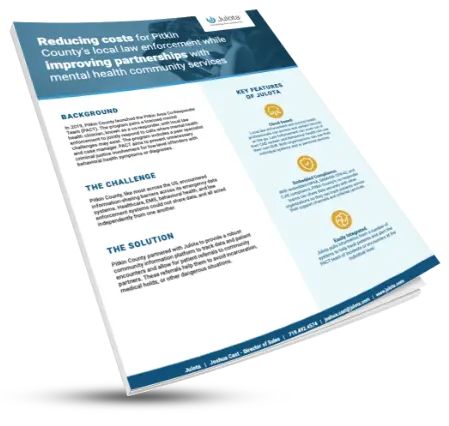
The three layers above all start after the phone rings. The highest-return use of AI in a crisis system starts before it, with the people a program already knows. Julota’s platform connects the records of the agencies that serve the same person, and two of its capabilities use that connected data to get ahead of a crisis.
Agency-defined early warnings. An agency picks three or four criteria that signal someone is heading toward a crisis, such as repeated emergency room visits or repeated 911 calls. Julota watches the connected data sources for people who match. When someone does, it alerts the appropriate care team and sends a referral, so the team can reach out and enroll the person in services before the next call. The criteria are the agency’s, not the vendor’s, and the alert goes to a person who decides what to do with it.
Getting ahead of evictions. Programs can scan sheriff’s eviction notices and flag the people a case manager already knows. Housing loss sits upstream of a large share of crisis calls, and the notice is public weeks before the lockout. Outreach can step in before someone loses their housing, not after they are on the street.
Neither capability scores strangers or predicts crime. Both work on people who are already clients of a program, using data the program is already permitted to see under the person’s consent and the HIPAA, CJIS, and 42 CFR Part 2 rules the platform enforces. That is the difference between early warning and surveillance. The co-responder and crisis intervention page describes the record these alerts run on.
What Is Still a Pilot?
One project deserves a mention because it is aimed directly at co-responders. Kennesaw State University’s Modular Agile Deployment Lab is building an AI tool that reads 911 incident reports to detect behavioral health crises and surface them to a co-responder. The lab tested an alpha version with a police co-responder in the summer of 2025 and is working toward a beta. It is research, not a product, and it is the right research: it starts from the report the officer already wrote and asks which of those people a clinician should see next.
What Should AI Never Decide on a Crisis Call?
Every tool in this guide shares one design rule, and a CIT coordinator should hold any new vendor to it. AI can rank a queue, translate a caller, draft a report, score a recorded call, and flag a client who matches criteria a human wrote. It should not decide that a person is dangerous, that a call gets a patrol car instead of a clinician, that someone meets the criteria for an involuntary hold, or that a case is closed. Those decisions carry legal weight, they are made under state statute and local policy, and they are the reason a trained person is on the call at all. The practical test is simple: if the vendor cannot show you where the human reviews and overrides the output, the tool is not ready for crisis work.
The second rule is data. A crisis team’s AI is only as good as the record it reads, and most teams’ records are split across CAD, an ePCR, a clinician’s EHR, and a spreadsheet. Our guide to crisis center software covers the coordination record that makes any of these tools worth running, and the co-response evaluation plan shows how to measure whether they changed anything.
Frequently Asked Questions About AI Tools for Crisis Intervention Teams
Does 988 use AI?
Not to answer calls. 988 centers are experimenting with AI for quality review of recorded calls, such as the NIMH-funded Lyssn and Protocall study, and for counselor training through simulators like ReflexAI. A trained counselor still takes every contact.
Can AI decide whether to send police or a clinician?
No, and no tool in this guide claims to. AI can transcribe the call and put the center’s transfer protocol on screen. The call-taker applies the protocol.
What is the first AI tool a small CIT program should look at?
Whichever one fixes the problem you can measure. If reports eat your co-responder’s shift, look at Draft One or Eleos. If the same people keep calling, look at early-warning alerts on your own record. If your 911 center has no 988 transfer protocol, no AI will help until it does.
Are these tools HIPAA and CJIS compliant?
Each vendor answers for its own product, and a crisis program has to check every one, because a co-responder record carries both health and criminal justice data. Our post on HIPAA and law enforcement in mental health crises explains why.
Related reading
- Crisis Center Software: What 988 and Mobile Crisis Teams Actually Need
- Alternatives to 911 for a Mental Health Crisis: What They Look Like Heading Into 2027
- How to Build a Countywide Crisis Intervention Team
- Why Clinicians in Law Enforcement Are Becoming Essential to Modern Policing