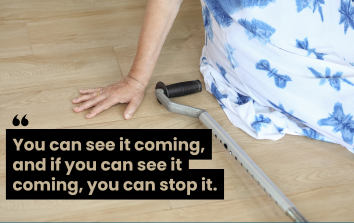
I ask the same question at the start of every strategy session: Do you know there are two types of high utilizers across the USA? Lift assist calls are actually made up of two very distinct callers. They are not cut from the same cloth. And most of our data treats them like they are. There are the falls, and there are the calls.
I ran a fire department MIH program for seven years before I came to Julota. I know that bucket from the inside.
The falls are our seniors. We knew their names. We knew the address. Half the time we knew the dog. We knew why they called before we got there. Most of the time we helped them up, made sure they were okay, and left without a transport.
The calls are our multi-visit patients. When they call, we do not know what is really going on with them yet. Figuring that out is the work.
Put both groups in one high utilizer bucket, and the seniors disappear. That costs us in two ways. Fall prevention for seniors has some of the best return on investment in all of community health. And the two groups get paid for through different doors.
Here is the case, in five points:
- The Falls Are a Known Population
- The Calls Are an Unknown Population
- The Falls Pay Back the Most
- This Is a Medicare Population
- The Data Must Live Separately
One Bucket, Two Populations
A 2026 study of 9.5 million EMS encounters found that about 3% of patients made up 16% of all responses, and the heaviest users came back about every 10 days.
That number is real. It just does not tell you who those people are. Most agencies count by call volume and stop there. So, a 92-year-old who falls every week and a 45-year-old with uncontrolled diabetes and no doctor end up on the same list.
They call for different reasons, need different teams, and pay back in different ways. And when you blend them, the falls go missing, because a fall usually ends with no transport, and no transport almost never makes it into the report a funder reads.
The Falls Are a Known Population
Same name, same address, same reason. Any crew can tell you who these folks are before the tones drop. The research agrees:
- Falls are about 2% of all EMS calls. In one EMS system they were 11.5% of calls for adults over 60, and lift assist calls there rose 268% in a decade.
- Most end with no transport. After a fall, 11% to 56% of patients refuse, compared with 5.1% for adult calls overall.
- They come back. Nearly half of lift assist patients call for another lift assist within two weeks.
The path is always the same. Fall → help up → no transport → fall again → the ED → a fracture → a hospital bed.
I have watched it play out more times than I can count. But you can see it coming, and if you can see it coming, you can stop it. That is what an Aging in Place service does. A home safety check. Strength and balance. A hard look at the medication list. The right help in the home before the next fall, not after.
The Calls Are an Unknown Population
The 911 call is the symptom. The cause could be heart failure, COPD, diabetes, mental health, substance use, no doctor, no food, or no ride.
Frequent EMS users are more likely to be on Medicaid, live in vulnerable neighborhoods, and carry chronic disease. They get transported more often than one-time callers, and they are about 40% less likely to be admitted. We keep bringing them to the one place that cannot fix what is wrong.
This group needs a Multi-Visit Patient (MVP) service. Figure out what is really driving lift assist calls, build one care plan everybody shares, and get the person to the partners who can actually fix it.
The Falls Pay Back the Most
Fall prevention for seniors pays back several dollars for every dollar you put in. Across more than 275,000 older adults in evidence-based fall prevention programs, the return ran from $8.36 to $38.04 per dollar. When one EMS system built fall screening into 911 calls and sent community paramedics into the home, fall-related 911 calls dropped 37.2%, patients’ health status improved by 29.5%, and estimated savings were $19,053 per enrolled patient.
It works because we already know who the patient is, and the fixes are not fancy. Grab bars, a medication review, and a balance class cost next to nothing compared to one hip fracture.
Doing nothing is expensive. Fall injuries in older adults drive about 2.3 million ED visits and 922,000 hospital stays a year, at $19.8 billion. Government programs, mostly Medicare, pay about 75% of nonfatal fall costs.
This Is a Medicare Population
That 75% is the whole point. The falls are a Medicare population. Every fall we prevent is a Medicare dollar saved.
Medicare already asks for fall screening through the Annual Wellness Visit. It just is not reaching people. In one Washington State study of Medicare patients with a likely fall injury, only 22% had a wellness visit and only 15% had a full fall risk assessment. Who is in the living room after the fall? We are. EMS.
Medicare already pays for two programs that do this work.
PACE, the Program of All-Inclusive Care for the Elderly, keeps nursing-home-eligible seniors living at home with a care team, home visits, and coordination. Medicare and Medicaid pay a flat monthly rate per person. That is Aging in Place with a paycheck. A June 2026 HHS study found PACE participants had lower hospitalization, ED use, and death rates than seniors in other plans. Yet only about 95,000 people are enrolled, and just 4% of eligible seniors can even access one. The model works. It just cannot reach most communities.
Transitional Care Management is a Medicare service, billed since 2013. It pays a practice to follow a patient for the 30 days after discharge. Sound familiar? That is the MIH Transitional Care service. In a study of 18 million Medicare discharges, patients who got it cost less the following month, and their death rate was 1.0% versus 1.6%. Even so, most practices never bill it, partly because they do not know when a patient was discharged. EMS knows. We were at the house.
So here is where I land. CMS has already decided this work is worth paying for. It pays PACE to keep seniors home. It pays doctors’ offices to manage the 30 days after a discharge. MIH programs do the same work, in the same homes, for the same Medicare population, in towns PACE will never reach, with crews who already know the patient by name. We are not missing evidence. We are missing a way to bill. Plain and simple.
The Data Must Live Separately
Every MIH program is a snowflake. See one, you have seen one. But the bill cannot be a snowflake, and neither can the data behind it.
The biggest reason to split the falls from the calls is reimbursement. Medicare does not pay for a pile of repeat callers. It pays for a defined service to a defined beneficiary with a documented need. If a senior’s fall prevention visits are sitting in the same record as a 40-year-old’s behavioral health navigation, there is no clean claim to send and no clean report to hand a plan.
Medicare and Medicare Advantage pay for the falls. Medicaid, hospitals, and grants pay for the calls. Separate data is what makes Aging in Place billable.
And we cannot afford to sit on this. About 4.1 million Americans turn 65 every year through 2027. One in four older adults falls every year, and fall deaths are up 51% over the past 10 years. The 911 system feels it first, and today no funding follows those calls. Do not wait for a billing code to build this.
What Needs to Happen
To CMS: recognize EMS-based MIH programs as Medicare providers for Aging in Place and Transitional Care for people 65 and older. Start with the codes that already exist, and build toward direct EMS billing.
To agencies:
- Split the high utilizer report in two, falls on one side and calls on the other.
- Count every lift assist, transport or not, and tie it to a name and address.
- Route repeat falls to Aging in Place and repeat medical, behavioral, or social calls to MVP.
- Measure each on its own terms, and report the return by service, so funders see the senior return instead of an average that hides it.
High utilizers are not all cut from the same cloth. See the lift assist calls for who they are, and we serve both better. And we can prove it.
Let’s Talk About Your Lift Assist Calls
I live this stuff, and I want to help. At Julota, we connect your MIH program to the hospitals, health departments, and partners who share your patients, and we keep the falls and the calls in their own lanes, with the data to prove what each returns. If you are building or growing a program, book a strategy session with me, bring your team, and leave with a strategy plan. More consulting options at julota.com.