
Pre-Arrest Diversion vs. Court Diversion
Pre-arrest behavioral health diversion happens before anyone is charged. Law enforcement or another responder intervenes before an arrest is made and directs the person toward behavioral health services instead.
Court (post-arrest) diversion is different. The person has already entered the criminal justice process, through an arrest or a citation, and the prosecution then decides it is more appropriate for them to complete a diversion program.
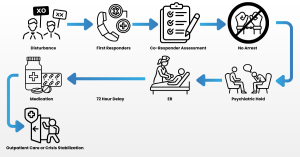
Here is one example of how the process can work. Not every pre-arrest diversion program follows this exact sequence:
Jurisdictional Variations
The US can be thought of as fifty separate countries, each with its own laws, procedures, and professional jargon. Different jurisdictions have different combinations of law enforcement diversion, EMS, co-responder programs, emergency departments, crisis centers, statutory holds, voluntary treatment, and other options.
Depending on the jurisdiction, someone can be taken for emergency psychiatric evaluation under civil commitment law, and the legal authority, criteria, duration, and process can differ substantially (Hedman et al., 2016). An involuntary psychiatric hold is not necessarily the same thing as behavioral health diversion.
How Pre-Arrest Behavioral Health Diversion Works
Behavioral health diversion moves people who are seriously and chronically mentally ill1 out of correctional facilities and into treatment. The pre-arrest component is about preventing people from entering the system in the first place. It typically follows these steps:
- A mentally ill individual is acting out in public, creating a disturbance or threatening public safety. Law enforcement officers and/or EMS respond to the scene.
- A behavioral health co-responder, embedded with police or EMS or staged nearby, determines that the individual is seriously mentally ill and/or under the influence of drugs or alcohol.
- In accordance with departmental policy, local ordinance, and state statute, the person is placed on an involuntary psychiatric hold rather than under criminal arrest.
- The person is transported to a local emergency room for an in-depth evaluation.
- They are held for 72 hours, or whatever time frame the statute allows (Morris, 2021). They may receive medication for psychiatric stabilization and then be referred to outpatient care or to interim care at a short-term crisis stabilization residence.
Decision Points in Pre-Arrest Diversion
Responders weigh safety, legal authority, the nature of the crisis, and what resources are actually available before choosing diversion. These are the key questions:
- Immediate safety concerns: Does the subject pose an immediate threat to police, other first responders, bystanders, or the public?
- Long-term safety concerns: Is the subject well known to law enforcement and EMS? Is there a long history of catch-and-release? The repetitive cycle of police contact, arrest, a brief incarceration or psychiatric hold, and then release to re-offend hurts the morale of first responders, the public, and the subject.
- The nature of the crisis and fit for pre-arrest diversion: Does the subject’s behavior point to severe and chronic mental illness, acute substance intoxication, both, or an acute episode of emotional disturbance?
- De-escalation: Can the subject be de-escalated safely?
- Rapport and basic needs: Would offering food, water, a cigarette, or another comfort help build rapport or manage agitation? The long-term health effects of tobacco are a real concern, but in my experience a cigarette can quickly bring an agitated person down to a manageable level.
- Legal authority: Is pre-arrest diversion allowed under departmental policy, local ordinance, and state law?
- Diversion eligibility: Do the nature of the offense, outstanding warrants, or ongoing safety considerations make diversion inappropriate?
- Subject cooperation: Will the subject voluntarily agree to transport, evaluation, treatment, detoxification if indicated, or other available interventions?
- Involuntary intervention: If the subject refuses voluntary intervention, are the criteria met for involuntary evaluation, transport, or a psychiatric hold?
- Availability of resources: Is an appropriate destination identified and available, such as an ER, a mental health crisis stabilization unit, or a detoxification facility?
- Follow-up: Once the immediate crisis is addressed, is follow-up available so the subject does not fall through the cracks, reemerge to create further public disturbances, and keep suffering?
The Goals of Pre-Arrest Behavioral Health Diversion
Pre-arrest diversion exists to address two concerns at once. People in serious behavioral health crises are a poor fit for the criminal justice system, and communities still expect lawmakers and first responders to deal with violence, disorder, property damage, harassment, and threats to public safety. Pre-arrest diversion is one tool law enforcement and behavioral health systems can use to address both.
Reported advantages include cost savings and a greater emphasis on justice. Many people with mental illness are currently housed in inappropriate settings such as correctional facilities, where they may be victimized by other inmates or their psychiatric condition can destabilize and deteriorate further. They may or may not have access to medication and psychiatric care, and correctional officers may or may not have training and experience working with the severely mentally ill. The goals of pre-arrest diversion that address these problems include:
- Reduced use of incarceration for people experiencing behavioral health crises
- Connection to community treatment options
- Potential reduction in criminal justice involvement, with cost savings
- Better use of law enforcement resources
Officer Safety
Officer safety is paramount. The safety of officers, other first responders, bystanders, and the community in general is non-negotiable. Compassion, fairness, and officer and public safety are not contradictory goals, and tending to someone in a mental health crisis or under the influence of drugs or alcohol does not override safety considerations.
Cost Containment and Systemic Pressure Relief
For a diversion program to last, two things have to be true:
- It must be cost-effective enough that stakeholders are willing to fund it.
- It must relieve enough systemic pressure to justify its existence.
Public Perception
A diversion program has to look good to the public without overriding public safety, and public opinion here is polarized. Many people object to the mentally ill being arrested, and there have been many widely covered incidents in which seriously mentally ill people were acting out and police officers have responded with deadly force. Suicide by cop is a dreaded, lose-lose situation.
Others are weary of homeless people with mental illness vandalizing their businesses, shoplifting, and harassing or intimidating customers. City residents may no longer feel safe in public spaces. Many people hold both concerns at the same time: they worry about the inappropriate incarceration of people with mental illness and about the safety and property issues that come with behavioral health crises.
Conclusion
Pre-arrest behavioral health diversion gives law enforcement one more option for finding the balance between equitable treatment and public safety.
Endnote
1 The term “severely chronically mentally ill” is a descriptive category, not a diagnosis. Diagnoses in this category include schizophrenia, schizophreniform disorder, bipolar disorder, borderline personality disorder (in an acute acting-out phase), and PTSD in an acute phase of exacerbation. Rendering a diagnosis falls outside the role of first responders. Still, recognizing erratic and disruptive behavior that fits the category of severe and chronic mental illness is part of deciding to divert.