How Should Police Respond to a Mental Health Crisis Involving Firearms?
Police responding to a mental health crisis that may involve firearms follow the use-of-force continuum, treating lethal and less-than-lethal force as a continuum of probability, while distinguishing a psychotic episode or extreme emotional state from willful criminal action. Preparedness means assessing the scene, identifying risks, recognizing suicide-by-cop behavior, and using the minimum force that keeps the subject, officers, and bystanders safe.
Key Takeaways
- Safety comes first whether the subject has a severe mental illness or criminal intent.
- The use-of-force continuum still applies, but the goal is containment, not punishment.
- Suicide by cop has recognizable behavioral and tactical signs.
- How the public sees a mentally ill person restrained shapes trust in the department.
What Are the Field Realities of Police Response to Mental Health Crises?
Police officers are frequently called to intervene in situations where someone is behaving erratically, creating a disturbance, and endangering themselves and bystanders. While it is important to differentiate someone in an extreme emotional state or having a psychotic episode from willful criminal action, a reasonable amount of force may be needed to contain them. Police response to mental health crisis requires safety regardless of whether a suspect has a severe mental illness or is engaging in intentional and willful criminal action.
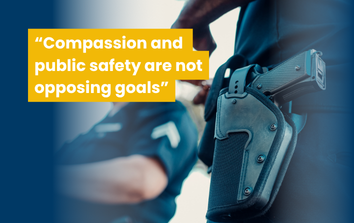
When the public witnesses a severely mentally ill individual being restrained roughly or when lethal force is used, there tends to be public outrage. But compassion and public safety are not opposing goals. Better treatment reduces suffering and dangerous public behavior, which reduces the burden on police and may reduce controversial use-of-force incidents.

I am going to explore the continuum of force from lethal to less than lethal and offer feedback on dealing with calls involving the mentally ill acting out.
What Is the Use-of-Force Continuum?
Until the mentally ill receive proper treatment, effective Police Response to Mental Health Crisis situations remains essential, requiring officers to defuse volatile encounters without resorting to excessive force or loss of life. The use of force ranges from presence to lethal force. This model will vary among departments/agencies. Always default to department/agency protocols.
- Deterrence & Command presence
- Ask, tell, make.
- Chemical weapons such as OC (Oleoresin Capsicum).
- CEW’s (Conducted Energy Weapons), e.g., a Taser\
- Hands-on grappling and striking.
- Impact weapons, including the ASP (Armament Systems and Procedures) Collapsible baton.
- Less-than-lethal kinetic impact weapons, e.g., baton rounds or bean bag rounds.
- Firearms
Deterrence by presence is established when an LEO (Law Enforcement Officer) is neat, squared away, in good posture, and fit. In my work with crime victims, I have encouraged people to develop a deterrence presence so they appear to be less attractive targets to potential predators. Violent individuals will choose their victim intuitively, based on an algorithm they unconsciously run to determine who will be an easy target. Suspects will choose to resist arrest partly because they think they can prevail and escape. Deterrence presence will initiate their abort criteria; they will say to themselves Bad idea, not that one, ” or “Even if I win, I will get too banged up in the process, so it is not worth it.”
Command presence is a strong voice, decisive commands, and a presentation that says you are in charge here; you give orders with the expectation they will be obeyed. Ask a suspect to do something; if they do not, it is no longer a request but an order. If they do not follow the order, make them do so.
Hands-on refers to making physical contact with the suspect and using pain compliance holds, pressure points, leverage, or superior strength to induce compliance or subdue a suspect for handcuffing or other restraints. A strong suspect or one who is an experienced street fighter or trained in grappling and is non-compliant will be a challenge to contain, as will a subject in a state of severe agitation or under the influence of substances.
How Do Lethal and Less-Than-Lethal Force Fit on a Continuum of Probability?
A lethal weapon has a very high probability of causing death or severe injury. A less than lethal weapon has a low probability of causing death or serious injury, though that is still possible. This is not a dichotomy; it is not that one weapon is exclusively lethal and the other is exclusively less-than-lethal or non-lethal. It is a matter of probability.
How Do Officers Prepare for Behavioral Health Encounters?
Assess the scene & identify risks:
- Never forget the basics: watch the hands. Hands kill.
- Is the subject wearing clothing that is sagging on one side, indicating a heavy object in a pocket that could be a weapon?
- Are there weapons or objects that could be used as weapons visible?
- Are they displaying pre-attack indicators?
- Eyes focusing
- Intake of breath
- Nostrils flaring
- Blading their body
- Tensing shoulders
- The most obvious, stated intent, e.g., I’m gonna hurt you.
- Is the subject showing indicators of intoxication?
- Slurred speech
- Ataxia (staggering, difficulty maintaining balance)
- Labile mood ( rapidly shifting mood, from cheerful to angry to tearful
- Hypersensitive to provocations and aggressive e.g., what did you say? Excuse me?
- Is the subject making delusional statements or responding to auditory hallucinations?
- Yelling to or conversing with people not in the room
- Shifting attention and listening to someone not present.
- Grandiose or implausible statements
Responding to a call with an apparently mentally ill subject:
- They may not respond to verbal commands due to psychosis, not resistance. They may be unable to determine which is an actual voice and which is a product of their own mind.
Make concrete, repetitive statements, and avoid abstraction, as psychotic individuals can experience cognitive overload and escalate in response to abstract statements. - It may escalate a subject if you confirm or deny delusional statements. A neutral, matter-of-fact statement, e.g., I don’t know anything about that, or I have not heard of that, may be more effective.
- A state in which a subject may not perceive pain from compliance holds until much later is if they are hyperadrenalized, some times referred to as hyperactive delirium with severe agitation.
- Use of co-responders, embedded behavioral health providers who accompany LEOs to deescalate and provide proper referral for treatment.
- Basic counseling skills for first responders can be taught and utilized to deescalate disturbed individuals.
Suicide by Cop: Behavioral and Tactical Considerations:
Some people have decided to die but cannot do it with their own hand. They will antagonize and provoke an LEO into doing it for them. There is a recognizable subset of cases where they have gotten up that morning prepared to die and will not be responsive to de-escalation.
Bodycam Shows Officers Pleading With Armed Man Before Shooting
- Behavioral indicators: Someone brandishing a weapon or concealing their hands, and unresponsive to repeated commands to show their hands or drop their weapon.
- Warning signs: It may be very obvious; a suspect walking toward you with a knife yelling Shoot me.
- Decision-making: it may have to occur in less than a second. There is the frequently cited 21-foot rule, aka the Tueller drill, in which the average untrained individual can close 21 feet faster than a trained individual can draw a firearm, acquire the target, and fire accurately.
- Tactical implications: the choice between less-than-lethal and lethal weapons must be made quickly.
- Communications: one person talks. A single voice issues commands, so if there is a possibility of compliance, the suspect will have the best opportunity to respond.
- Containment: prevent bystanders from wandering into the scene.
What Are the Operational Implications for Police Response to Mental Health Crises?
The public lacks the training or experience to critically assess the actions police officers must take under extreme stress. In far less than the amount of time it took me to write that sentence, a police officer may have to make a life-and-death decision. Discipline and emotional regulation must balance reactivity.
A police response to mental health crisis requires blended competencies, coordination, and communication among LEOs, EMS, co-responders, hospital ERs, and local mental health agencies.
Persistent system gaps include the presence of the severely and untreated mentally ill in the community, instead of in an appropriate safe environment, and restrictions as to when a mental health professional can authorize an involuntary transport and hold. Statutory changes to address this are another need for improvement.
Future directions for training and policy can include innovation in more effective less-than-lethal methods and stopgap measures, such as the use of co-responders.
————————————————————————————————————————————————
Disclaimer: I have never been a law enforcement officer or corrections officer. My perspective differs from that of someone who has made split-second tactical decisions or been responsible for controlling a dangerous scene.
My professional experience is from behavioral health, where I have spent my career assessing and managing high-risk situations involving suicidal crises, homicidal threats, severe emotional distress, and acute behavioral instability. This has included verbal de-escalation, crisis intervention, and coordination with multiple parties, including law enforcement, EMS, and crisis services.
This article is based on my professional experience, a review of the literature, and an examination of real-world incidents, including body camera footage. I recognize the limitations of each of these sources.
My goal is to contribute a behavioral health perspective to the discussion of police encounters with individuals experiencing severe mental illness and behavioral crises, emphasizing how mental health professionals can collaborate with law enforcement to improve outcomes and inform policy.
————————————————————————————————————————————————-
Related reading
- Don’t Overlook These Resources and Crisis Response Partners
- Police Behavioral Health Units and Hospital Billing: What They Share
- Mental Health Response Challenges and What to Do About It