Note: Much of the following is based on my experience and opinion, with empirical data and evidence where indicated. The experience of the reader may differ.
What Do Police Behavioral Health Units and Hospital Billing Departments Have in Common?
Police behavioral health units and hospital billing departments both clean up messes in systems that were never built for prevention: they figure out who is legally and financially responsible, contain costs in overloaded systems, and manage social problems that keep growing. The comparison sounds like a grim joke, but it shows that co-responder programs, like billing departments, exist because upstream health and public policy failed.
Key Takeaways
- Both units are cost-containment efforts in overloaded systems.
- Both determine responsibility for a problem someone else created.
- Co-responder units are a response to policy failure, not a cure for it.
- Recognizing that is the first step to fixing the upstream problem.
Introduction
Short, dark & cynical answers:
- They both clean up a mess in systems that were not geared toward prevention.
- They figure out who is legally and financially responsible for said mess.
- They are both efforts at cost containment in overloaded systems.
- They are complex and costly efforts to rein in social problems that continue to grow.
A more refined answer:
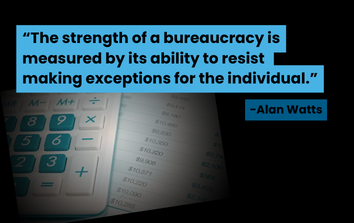
Police Behavioral Health Units, aka Co-responder programs, and hospital billing departments share some common characteristics. They are both multi-layered systems designed to manage complexity, risk, and scarcity for at-risk and vulnerable populations. They are making efforts to allocate resources and maintain equilibrium with unlimited public demand. Both are parts of vast and rigid bureaucracies:
The strength of a bureaucracy is measured by its ability to resist making exceptions for the individual.
— Attributed to Alan Watts=

What Do Hospital Billing Departments Actually Do?
The U.S. healthcare system combines high costs for care with administrative complexity, rigid bureaucracy, fragmented financing, and extensive use of specialists. The U.S. health care system is characterized by innovation, decentralization, private-sector participation, and high-end capacity, with cost containment added later and inconsistently.
That produces advanced medical technology and service delivery, more accurate diagnosis, less invasive and painful treatment, faster recovery time, shorter waits for procedures, and people surviving medical events that would have claimed their lives 30 years ago. This progress has also led to high administrative costs, inconsistent access to care, sometimes crushing medical debt, significant price variation by region, and financial losses for hospitals and providers from writing off debt that patients will never be able to pay.
Massive Administrative Overhead: This includes third-party payors (aka health insurers), billing rules, prior authorizations, networks, and coding systems; teams dedicated to insurance billing and claims; corporate compliance; debt collections; quality assurance; utilization review; and fee contract negotiation.
Routine surgery, such as an inguinal hernia repair, costs up to $7,500. This is the cost billable to the patient or their insurance. The bundled hospital costs include pre-op administrative check-in and payment, pre-op nursing assessment, IV, catheter, and saline, OR surgeon, anesthesiologist, OR nurses and technician, post-op nurse, and surgical follow-up — plus all the supplies that go with it. Seriously, they give you Pepsi and graham crackers at my local hospital.
Health Insurance / Third-Party Payor Structure: For many people, insurance coverage is an employment benefit. Others receive health insurance subsidized by the state (e.g., Medicaid) or by the federal government (e.g., Medicare). This can produce fragmented risk pools and complex negotiations between employers, insurers, and providers. Employees, their unions, and lobbyists will also influence which plans are available and their associated costs.
Profit Extraction at Each Layer: Third-party payors, pharmaceutical companies, hospital and outpatient clinic networks, medical device manufacturers, and their intermediaries can collect profits, which influence costs and service delivery.
Contributing factors to the high healthcare expenses in the United States include a multi-layered institutional structure that combines clinical service delivery, financial and legal liability management, corporate compliance, and administrative oversight — each of which has its own independent cost center. Hospital billing departments grew larger and more complex every year because health care payment was fragmented across multiple sub-departments and stakeholders, which in turn drove up health care costs.
What Do Police Behavioral Health Units and Co-Responder Programs Do?
Co-responder programs emerged because police were overseeing mental health crises and drug overdoses outside of their training and the scope of law enforcement. This led to allegations of excessive or inappropriate use of force, which the media was quick to pounce on, and the public was quick to consume without critical consideration.
The closure of state psychiatric hospitals has led to an epidemic of severely mentally ill people who are homeless and have either turned to drugs and alcohol for comfort, or their use of drugs and alcohol has contributed to their homelessness. The criminal justice system is bloated, complex, multi-layered, and more about resolving a situation than about the actual delivery of justice.
I have witnessed travesties of justice, where sex offenders walk out of court with a desk appearance ticket, not even a bond. They learn they can do as they please without consequence. I have seen the same mentally ill and addicted individuals in my community urinating publicly, harassing passersby, and having loud and intense arguments with their hallucinations. They are disturbing the public peace, and suffering themselves — exposed to extreme weather, deprivation of basic human needs. They are victimized by their aggressive peers or cruel members of the public.
I have seen people with an addiction slowly killing themselves with heroin and fentanyl, and they are repeatedly freed to continue until they kill themselves quickly with an OD. There is little justice to be seen from where I am standing.
What Police Behavioral Health Units and Billing Departments Actually Do
A co-responder influences the decision-making process for someone who is incarcerated, hospitalized, sent to court diversion, or stabilized in the community and sent on their way. Co-responders coordinate with police, EMS, mental health and substance abuse providers, homeless shelters, housing placement, the courts, and families. Police co-responders deal with the mentally ill and addicts, and work to mitigate the risk they pose to themselves and others.
A billing department is instrumental in determining whether a patient incurs significant debt, whether they receive adequate follow-up care, or whether they are denied care. The hospital billing department influences decisions about who gets care, what kind of care, and the duration of care — often more than providers do. Billing departments coordinate physicians and other clinicians, third-party payors, billing and coding staff, corporate compliance staff, and the patients.
Both rely on reports, coding, compliance, audits, chain of custody, and strong legal exposure. Liability management, documentation standards, regulatory compliance, and mandatory procedures are shared features. Both rely on classification systems that do not always concur with the complexity of human lives. It is difficult to neatly stuff people into narrow categories without losing key components.
How Do Both Reflect Failures in Health Care and Public Policy?
Workers in both the criminal justice and health care systems are prone to burnout because they are constantly exposed to the worst of human nature and suffering. To compound this, faceless, uncaring, and inflexible bureaucracies bind them, and the imposition of rules made in a vacuum by people far removed from the daily realities of the job.
People who truly care for people become disillusioned and leave the field. Others become corporate drones, with unquestioning adherence to the rules without consideration of downstream consequences. In both settings, frontline staff carry the potential for moral stress injuries. Hospital staff may be pressured to deny care to a patient who will suffer without it. Police may have to enforce laws with which they do not agree. Co-responders may be in the difficult position of knowing what is needed, but also knowing the resources are unavailable. Staff may feel they are trying to help people while also having to enforce institutional rules they did not design.
Conclusion
Comparing police behavioral health units and hospital billing departments reveals parallel efforts to mitigate harm and manage scarce resources. Police behavioral health units are partly working to contain costs and prevent high health care expenditures driven by the chronically mentally ill and those struggling with addiction. Hospital billing departments are gatekeepers that influence access to healthcare and reimbursement. Both operate within rigid, hierarchical structures.
Porter, D.A. (2026a). Opioid Overdose Response for First Responders: Signs, Narcan & Safety. Julota.