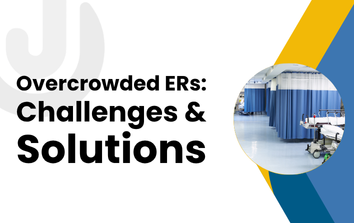
Overcrowded ERs are not isolated incidents. Most of the time, overcrowding is a result of having too many patients and not enough staff. However, as you’ll see, there are ways of combating this issue. Some ways to reduce overcrowding include conducting surveys, preparing for the long-term journey toward stability, and finding ways to implement immediate relief.
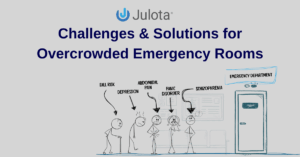
Overcrowded Emergency Rooms and How to Reduce Bottlenecking in the Waiting Room
When an emergency room becomes overrun, it’s easy to start assigning blame. However, this problem isn’t going away unless healthcare systems start thinking about real solutions. Throwing up our hands isn’t an option.
While we may not be able to fix this problem overnight, hospital managers and EMS directors should realize that even a small amount of relief for ER overcrowding can go a long way. Too often, organizations approach problems with an all-or-nothing mindset. In fact, small steps in the right direction are progress. Like anything, it’s the slow building of positive momentum that yields long-term results.
With all that being said, let’s examine some of the challenges associated with hospital ERs and explore how to prevent the deluge of overcrowding from undermining a community’s health system.
Solutions to overcrowded emergency rooms:
- Conducting a Survey to Find Patterns of High ER Use
- Understanding that The Fix May Not be Instant
- Finding Ways to Deliver Immediate Relief (EMS is One of Them)
- Preparing for a Hands-On Approach (Rather than one based on information/pamphlets)
- Uniting the Community to Find Underlying Issues and Common Solutions (Spreading patients among local ERs)
You’ll find more details related to all these points in the following sections!
Solutions for Overcrowded Emergency Rooms: Conducting Surveys to Find Patterns in High ER Use
Here’s the thing. You might read an article about overcrowding on the internet (like this one) and notice that it mentions a particular reason for overcrowding. The tendency then is to latch onto this idea and believe that it is the only answer to your problems.
Indeed, use the experience of others to help guide you, but understand that the only way you’ll find lasting change is by taking a close look at your health system, and asking the question: why are we seeing so many people? Why don’t we have the resources to manage them?
In asking these questions, be careful to avoid the most straightforward, more dismissive answers. “People don’t know what an emergency room is for anymore,” or “These ambulance services need to stop bringing us these people.” Quickly jumping to conclusions only leaves your healthcare system blind to the real issues.
A better approach is to crave real data. This means that you go through the numbers and really try to understand the people in your community, what they want, what they aren’t getting, and why so many of them end up at the emergency room. In some cases, this assessment may be part of a specific needs assessment, where your hospital system determines why a large number of people are accessing the ER.
Often, when you take a serious look at things, you’ll be surprised at what you find.
Solutions for Overcrowded Emergency Rooms: Understanding that The Fix May Not Be Instant
In an earlier section, we discussed that the solution to an overcrowded ER may not come overnight. While there are effective strategies to find relief, we are all aware that healthcare is a complex and ever-evolving environment.
Desperate is undoubtedly a word that could describe packed emergency rooms around the United States. As such, it’s imperative that, before you make a decision, you take a moment to ensure that you’re not choosing a solution based on desperation.
While some areas have always dealt with packed emergency rooms (particularly those in high-population centers), the fact that this has been a big issue even in smaller areas points to the long-standing changes in healthcare. In short, it took us a long time to get here, and it may take us a long time to find solutions.
However, there is hope. Because many hospital systems have found solutions to overcrowded ERs, let’s talk about them.
Solutions for Overcrowded Emergency Rooms: Finding Ways to Deliver Immediate Relief (EMS is One of Them)
One way to deliver more immediate relief to overrun emergency rooms is to collaborate with EMS. Why? Often, ambulance services follow a simple process: they receive a 911 call, respond, and transport the patient to the ER.
However, if another step could be added to the ambulance response process, a significant change could occur. For example, if the ambulance responds but instead of automatically transporting to the nearest ER, they perform a detailed assessment and decide the best (potentially non-ER) location, this can immediately lead to fewer people at the ER.
If the ambulance is authorized to transport some patients to Urgent Care Clinics (as is the case in some alternative destination protocols), then there will be fewer patients in the ER. Furthermore, if the ambulance service has been trained and authorized to provide treatment in place – such as offering pain medication, wound care, blood draws, and even antibiotics – then people with non-urgent ailments can receive care in their homes rather than ending up in the ER.
While some of these ideas sound foreign, they are taking place all over the country. Under the careful guidance of a physician, community paramedics and EMTs have been able to take on some of the load and reduce the strain on the ED, and even help reduce hospital readmissions.
Solutions for Overcrowded Emergency Rooms: Preparing for a Hands-On Approach (Rather than one based on information/pamphlets)
What happens when the company you work for wants people to stop leaving their paper cups on top of the water cooler? They send an email. This would be what we might call an “information” solution. A practical solution would be to have someone stand next to the water cooler and instruct people to dispose of their paper cups after they’ve taken a drink.
When it comes to correcting ER overcrowding, there is undoubtedly a place for an “information campaign”; however, sometimes we need to be ready to take action. This means that, instead of sending a patient home with a pamphlet on “how to avoid secondary overdoses,” we might need to send an actual team to the patient’s house and help them with the transition to recovery.
How do you take action in the community? Community paramedicine programs are one of the most common ways health systems around the country are working to stop ERs from becoming overcrowded. Not only can community paramedics offer treatments to the patient (possibly limiting the number of treatments the patient needs in the hospital), but they can also be the person who “takes action” and actively helps keep that patient from returning to the ER.
Instead of telling a patient who is being discharged after a fall, “Hey, look out for those loose rugs in your kitchen,” the community paramedic can actually go to their house and remove the dangerous rug.
Solutions for Overcrowded Emergency Rooms: Uniting the Community to Find Underlying Issues and Common Solutions
One way to reduce overcrowding is to spread out the patient load more evenly. Some ERs will go on “diversion,” where they will inform ambulances that they are full, and it would probably be best if the patient went elsewhere (if possible).
The only problem with this is that an ER going on “diversion” does not amount to a conversation that unites the community. What may be more effective is for EMS and ER leadership to get together and discuss which ERs can handle which patients and how many.
If there are four ERs in an area, but only one of them can care for a complicated stroke patient, then they should allocate the stroke patients to that ER. However, perhaps the other ERs could help take on the sprained ankles and broken hips.
Of course, this can become complicated. Many times, local ERs are competing with each other. And even if they aren’t in direct competition, they are not part of the same hospital system. In these cases, someone will need to think about the greater good of the community and realize that avoiding overcrowded ERs is a win-win-win.
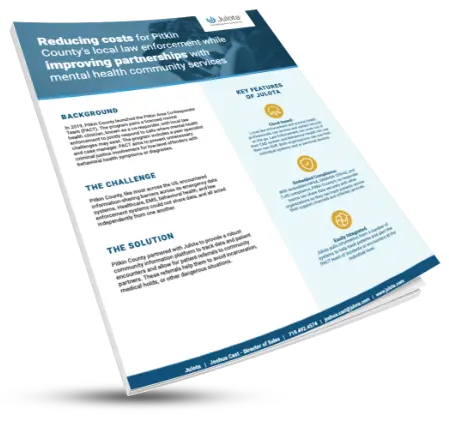
Tools like Julota can be used to facilitate conversation and communication between different hospital and EMS systems, with the goal of a more united approach to combat ER overcrowding.
Key Point:
ER overcrowding is a real issue. Thankfully, there are solutions. It’s essential to remember that the road to overcoming overcrowding requires endurance, but each step can bring relief.
Coordinating with EMS, taking action with MIH-CP, and collaborating with fellow health systems can make a big difference.
Contact Julota to see how their tools have helped services reduce recurring EMS runs, overcrowded ERs, and hospital readmissions. A representative would be happy to answer any questions you may have.