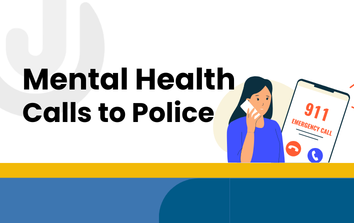
When it comes to mental health calls like the ones mentioned above, no one is calling 911 to have someone arrested or in trouble. They’re calling because they don’t know what else to do, and 911 is the only number they are confident will send help. But what exactly does that help look like? Is it the right kind of help? Or… is the help shaped by who is available rather than, perhaps, who is best for the situation?
How Many Mental Health Calls Do Police Run?
The answer to this first question is not as straightforward as one might think. And it depends on who you ask, how you ask, and when you ask. The first and easiest way to track the number of behavioral health calls police run is to look at the calls’ dispatch codes as mental health-related. This includes calls such as suicidal person, abnormal behavior, psychiatric problem, anxiety, etc. The variability in the number (and what likely creates a far lower number than the true number) is what is actually found on scene. Perhaps police were dispatched to a welfare check that turned into a mental health crisis. Or police were dispatched to a “threats” call that turned out to be paranoid delusions secondary to schizophrenia. Sometimes, police are dispatched alongside paramedics when safety is a concern. Perhaps someone is feeling homicidal because they were fired or are being evicted. 911 calls so frequently fall into the gray area that it can be difficult to come up with a reliable number. People have tried, though.
According to the Julota article The Role of Law Enforcement in Co-Responder Programs, approximately 10% to 20% of law enforcement calls have a mental health aspect. That means that, conservatively, one in ten police responses involves mental health. Given, however, how often mental health calls are initially coded as something other than mental health (like a disturbance, welfare check, or trespassing), that number is likely closer to one in five, especially when looking at largely populated areas. The article also notes that the number of mental health calls police are responding to has steadily increased over the past ten years. In some areas, that increase has been nearly 50%. In busy cities where the police are running hundreds to thousands of calls in any given day, 10%-20% represents a significant operational impact. And that impact eventually filters down to the individual in crisis. What type of response are they getting when they call for help? A timely one? A trauma-informed one? A safe one?
Unfortunately, the answer to these questions is not always a “yes”.
Why Does It Matter?
Police can do a lot. And many officers do it with skill and with compassion. But they are being asked to stand in for a gap in the healthcare and social support system that was not intended for them to fill in the first place. Mental health crisis calls are time-intensive. They often require a response that is focused on de-escalation, support, and care coordination, not enforcement. Yet as we have seen, police are frequently dispatched to these crisis calls, and many police officers do not have the time, training, or system resources to manage them in a way that is truly beneficial to the individual experiencing the crisis.
A good response requires slowing down the scene and figuring out what the person in front of you really needs. It’s looking at the social determinants that are driving the moment, like housing insecurity, food insecurity, financial stress, medication access, trauma, substance use, and lack of support. It’s spending time with the person and safety planning. It’s transporting the person to a crisis center if they need a place to go. And it’s setting the person up for some type of follow-up care in the future.
Each individual in crisis deserves to have that time and that level of attention. When it comes down to it, police officers do not have the capacity to spend that kind of time on 10-20% of their calls. It’s just not realistic. So, what ends up happening? The person in crisis feels rushed. They feel unheard. They escalate. Sometimes that ends in an unnecessary emergency room trip, sometimes an arrest, and sometimes, something even worse…someone gets hurt.
The Risk And The Criminalization of Mental Health
Individuals in a mental health crisis are disproportionately represented in police use-of-force incidents and fatalities. Sources estimate that approximately one quarter of fatal police encounters involve mental illness, and the risk of being killed in a police encounter is significantly higher for individuals experiencing a mental health crisis.
A quieter, but likely still detrimental consequence, is involvement in the criminal justice system. Several studies have been done on the criminalization of mental health. One review summarizing multiple studies highlights that a staggering one in four individuals with a mental health diagnosis has been arrested at least once in their lifetime. And, once someone gets pulled into the criminal justice system through a crisis call, an unfortunate and ugly cycle begins. Being in the system can disrupt consistent and stable treatment, destabilize finances and housing, and ultimately deepen poverty and stigma. This circles back to the discussion of the social determinants of health that can contribute to and fuel a mental health crisis in the first place. Public health research has even described how criminal legal contact can worsen existing social marginalization and disrupt linkage to services. Housing is a big part of that picture, too. Studies looking at homelessness and mental illness show that housing instability is associated with more police interactions. Put this all together,, and it starts to look like a lose-lose spiral, where the response to the crisis ultimately increases the chances of another crisis.
When we take away the small lens that crisis calls are often viewed through, the bigger picture shows us just how much and how urgently our current system needs help to change. And that change is already underway. This is where a new crisis number, specialized training, specialized response models, and more crisis centers come in. Together, they make it more likely that people in crisis get what they actually need and get it safely.
The Changes
The rollout of 988 created a clearer front door for mental health crises,, and Julota has highlighted how integrating 911 and 988 can help route the right level of response, rather than defaulting to law enforcement for all responses. What does the right response look like? Of course, the answer to that very much depends on the call, but having a mental health clinician as part of the response early is key.
That clinician support may look like a phone conversation through 988 that helps the person de-escalate and create a safety plan. It could look like an in-person response with a co-responder team, in which a clinician and a law enforcement officer respond together. Or it could look like an in-person response with an alternate response team, where the clinician takes the lead, and law enforcement is involved only when necessary. Either way, the individual in crisis is more likely to get what they really need in that moment, including time, stabilization, safety planning, and connection to follow-up care. And if stabilization is not in the cards on scene or over the phone, the person in crisis can be transported to a walk-in crisis center or a crisis stabilization unit (CSU). These approaches help keep people in crisis out of emergency rooms (unless necessary) and out of jails.
The Future
Police will always take a leading role in public safety, and some mental health emergencies will still fall within their realm. But they should not be the only option, and therefore the default responders, for mental health crises. The changes and progress that have already been made through 988, co-response, alternate response, walk-in crisis center,s and CSUs have already made a meaningful difference in mental health response over the past few years. Now, as a community, we need to keep building on this momentum so that more people in crisis get a better-tailored response first, and law enforcement support only when truly necessary.