
The Rural Health Transformation Program (RHTP) represents a landmark $50 billion investment in the future of American healthcare. For states and healthcare leaders in rural communities, it’s a once-in-a-generation opportunity to address long-standing challenges and build a more resilient, accessible, and sustainable care ecosystem. But this transformation isn’t about simply buying new equipment or building new facilities. It’s about forging a new digital backbone for rural health, one that connects disparate providers, empowers a mobile workforce, and puts patients at the center of their care. This is where Julota excels, offering a comprehensive software platform designed to meet the unique needs of rural health and maximize the impact of RHTP funding.
How Does Julota Build Lasting Rural Health Transformation Infrastructure?
Julota builds lasting rural health transformation infrastructure by giving RHTP-funded communities the digital backbone the program demands: true interoperability that breaks down silos between providers, tools that empower a mobile workforce, and data and analytics that prove outcomes. RHTP is a 50 billion dollar investment in rural care, and it is meant for connecting disparate providers around the patient, not for buying equipment.
Key Takeaways
- RHTP is a mandate for technological innovation, not a facilities budget.
- Rural healthcare has unique technology challenges: distance, connectivity, and fragmented partners.
- Interoperability, mobile workforce tools, and outcomes data are the three pillars.
- A practical roadmap for RHTP technology investment closes the article.
Why Is the RHTP a Mandate for Technological Innovation?
The Centers for Medicare & Medicaid Services (CMS) has been clear: the RHTP is a “catalytic investment” designed to spark systemic change. The program’s strategic goals are ambitious, aiming to:
- Make rural America healthy again through preventive health and chronic disease management.
- Ensure sustainable access to care by improving efficiency and coordination.
- Bolster workforce development to attract and retain skilled providers.
- Foster innovative care models that improve outcomes and reduce costs.
- Drive tech innovation to promote efficient care delivery and data sharing.
Crucially, CMS has earmarked RHTP funds for “technical assistance, software, and hardware for significant information technology advances.” This includes everything from consumer-facing health apps to AI-driven analytics and cybersecurity. The message is clear: the future of rural health is a connected one, and technology is the key to unlocking it.
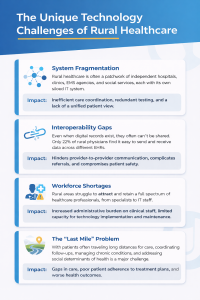
What Are the Unique Technology Challenges of Rural Healthcare?
While the Rural Health Transformation Program provides the resources, rural healthcare providers face a unique set of technological hurdles that urban and suburban systems do not. These challenges, born from geography, economics, and workforce constraints, have historically created a fragmented and inefficient care landscape.
Julota: The Unifying Platform for RHTP Success
Julota is not just another piece of software; it is a comprehensive, cloud-based platform designed to address the root causes of these rural health challenges. It serves as the connective tissue from the largest regional hospital down to the community health worker in the field
How Does True Interoperability Break Down Rural Health Silos?
Unlike traditional EHRs that are built for a single organization, Julota is designed for community-wide care coordination. Our platform connects hospitals, primary care physicians, behavioral health providers, EMS, social services, and public health agencies into a single, unified network. This creates a shared, longitudinal patient record that follows the patient across all touchpoints of their care journey. For RHTP-funded initiatives, this means:
- Seamless Referrals: A community paramedic or rural health clinic can refer a patient to a mental health specialist and track the outcome, all within the Julota platform.
- 360-Degree Patient View: An EMS provider responding to a call can see a patient’s allergies, medications, and recent hospitalizations, enabling more informed care in the field.
- Reduced Redundancy: With a shared patient record, redundant tests and procedures are eliminated, reducing costs and improving the patient experience.
Empowering the Mobile Workforce
Julota’s software design is tailor-made for the realities of rural healthcare. Our intuitive software empowers community health workers, paramedics, and home health aides to:
- Document care in the field: Capture patient information, vital signs, and notes at the point of care, eliminating the need for duplicative data entry.
- Manage tasks and schedules: Optimize daily tasks and schedules for home visits and follow-ups, ensuring that no patient falls through the cracks.
- Access critical information on the go: Pull up a patient’s care plan, medication list, or emergency contacts from anywhere, at any time.
Driving Outcomes with Data and Analytics
The RHTP requires states to demonstrate measurable improvements in health outcomes. Julota’s robust data and analytics capabilities provide the tools to do just that. Our platform allows you to:
- Track key performance indicators (KPIs): Monitor metrics such as hospital readmission rates, chronic disease management benchmarks, and patient engagement levels.
- Identify high-risk populations: Use data to pinpoint patients who are most at risk for poor health outcomes and target interventions accordingly.
- Generate comprehensive reports: Create detailed reports for CMS and other stakeholders, demonstrating the impact of your RHTP-funded programs.
A Practical Roadmap for RHTP Technology Investment with Julota
- Assess Your Ecosystem: Begin by mapping out your current network of providers and identifying the key gaps in communication and coordination.
- Define Your RHTP Goals: Determine which of the RHTP’s strategic goals are most critical for your community and how technology can help you achieve them.
- Implement the Julota Platform: Deploy Julota as the unifying platform to connect your entire care ecosystem and create a single source of truth for patient data.
- Empower Your Workforce: Equip your mobile workforce with Julota’s software to extend the reach of your care teams and improve patient engagement.
- Measure, Iterate, and Report: Use Julota’s analytics to track your progress, refine your programs, and demonstrate the value of your RHTP investment.
The Rural Health Transformation Program is more than just a grant; it’s a call to action. It’s a chance to build a future where every rural American has access to high-quality, coordinated care. With Julota as your technology partner, you can turn that vision into a reality.
For state-by-state detail, Julota’s RHTP Resource Hub follows every state’s Rural Health Transformation Program plan, with RHTP updates refreshed weekly and a guide to why interoperability is the key to success in RHTP.
Related reading
- Julota: A 24/7 Digital Homeless Outreach Coordinator
- Rural Behavioral Health Teams: Built to Serve, Struggling to Survive
- How Technology in Hospitals Builds Trust in the New Age of Population Health