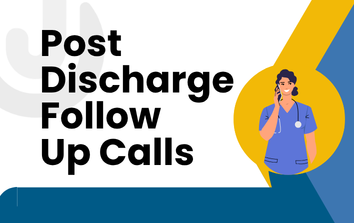
Post discharge follow-up calls reduce readmissions in several ways. First, they allow the mobile integrated healthcare (MIH) team to ensure that the person can adjust to their home life. Second, follow-up calls can ensure the patient meets all expected recovery benchmarks. Finally, it allows the MIH team to make real-world health adjustments that may keep the patient from needing readmission to the hospital floor.

The Ways that Mobile Integrated Healthcare-Community Paramedicine (MIH-CP) Reduces Hospital Readmissions
Hospital readmissions are a real problem. Not only do hospital readmissions mean patients may not be getting the care and follow-up they need, but they can also lead to potential reimbursement penalties.
Overall, it’s in a hospital system’s best interest to reduce the number of hospital readmissions. Not only does this greatly improve patient satisfaction, but it also means less strain on their resources and a potential increase in reimbursement.
There’s just one big problem. How do you do it? The quandary is this: the patient has been discharged from the hospital, so they are no longer under medical supervision, making it difficult to control their outcomes.
Thankfully, this is beginning to change. Instead of forcing patients into long, sometimes unnecessary stays, community paramedicine has taken a middle-ground approach. The patient can remain in their homes, the MIH team performs follow-up visits to ensure that they’re transition home is as simple as possible and that they have everything they need.
Just making this one change – connecting a person to an MIH professional – can have an impact on discharge rates. But MIH can do so much more, using training and techniques to drastically reduce the likelihood that someone will be readmitted to the hospital for the same disease for which they were just treated.
Let’s jump into some of the details of how MIH teams accomplish this task. By the end of this article, you should have a good idea of how you can get MIH professionals working to reduce hospital readmissions in your health system.
Here are the ways MIH works to reduce hospital re-admissions:
- Mobile Integrated Care Reduces Readmissions by Following Through on Patient Discharge Plans
- MIH Reduces Hospital Readmissions Within the First Months by Performing a Home Environment Assessment
- Reducing Hospital Readmissions via MIH Home Monitoring Tools
- Reducing Hospital Readmissions: MIH and Social Care (Mental Health, Substance Use, Housing)
Note: For any post-discharge follow-up program to be successful, it’s crucial for the MIH team to coordinate with the hospital providers. Community paramedics should be aware of the patient’s history, what to look for, and what recovery to expect based on the patient’s condition.
Mobile Integrated Care Reduces Readmissions by Following Through on Patient Discharge Plans
When a patient leaves the hospital, they are typically given a packet of papers that includes several things. They might have some prescription information, a few phone numbers to call if they should need medications, as well as a list of what they were treated for and how they should care for themselves when they get home.
There is also information on what to look for, when to call 911, and the number to call should they need to contact their physician.
This is all great stuff. However, this approach has a few problems.
First, the patient is usually anxious and excited to leave the hospital and return to their home life and family. While they may nod and agree to post-discharge plans, that doesn’t mean they fully understand them.
Second, there are many nuances to patient care. When the nurse and physician discuss post-discharge plans with their patients, they often don’t have the time to take the hour or two it might require to discuss the plans in depth.
With that said, even if the patient does fully understand the instructions for post discharge follow-up calls, there’s still a hurdle–the patient’s environment itself.
What the patient’s home looks like and how it’s set up is a huge X-factor in how the patient can practically implement their post-discharge follow-up. And that’s where the community paramedic can make such a big difference.
For example, let’s say that someone was discharged from the hospital after hip surgery. They are instructed to avoid stairs for a while and to be especially careful when they are using the bathroom or getting in and out of the shower. But in this situation, the patient has to climb a set of stairs to get into their home, and their shower/tub has a large ledge that makes it difficult and dangerous for the patient to get in and out.
All of these things directly contradict the discharge orders, and most of them are completely outside the patient’s control.
Even if the patient could find a way up the stairs or in and out of the shower, that doesn’t mean that they will be comfortable. When a patient is uncomfortable with their home environment, they are unlikely to stick with a post-discharge plan and more likely to end up back in the hospital.
Community paramedics address this issue by visiting the patient’s home after discharge and ensuring they have everything they need. If their environment needs changes (e.g., handles, ramps), the community paramedic can place an order and have them completed.
MIH Reduces Hospital Readmissions Within the First Months by Performing an Environmental Assessment
We touched on this a bit in the last section, but community paramedics can also reduce hospital readmissions by conducting a detailed assessment of patients’ environments. While healthcare professionals are often good at assessing patients, it’s easy to overlook the importance of where patients live.
We talked about handlebars and ramps, but other things can impact a patient’s health. For example, are there any animals in the house that could trigger an allergy or negatively affect someone?
Is there any mold in the house? Does the patient have proper heating and air conditioning? Does the patient have someone who lives with them who can help them out? On the other hand, does the patient have someone living with them who might not have their care in mind?
These are all critical questions that are very hard to answer without boots-on-the-ground access to the patient’s environment. When a mobile integrated healthcare team performs an effective environmental assessment, the likelihood of the patient returning to the hospital drops.
Reducing Hospital Readmissions via MIH Home Monitoring Tools
Another way that MIH teams can reduce hospital readmissions is by implementing monitoring tools during their post-discharge follow-up. For example, if the patient was hospitalized for dangerously high blood sugar, the MIH team can place a glucometer that remotely reports the patient’s blood glucose levels. Should the patient’s blood sugar rise again, the MIH team can catch it and address it before the patient needs to be readmitted to the hospital.
One thing that makes post-discharge follow-ups by community paramedics so impactful is that they can both assess and treat patients.
Reducing Hospital Readmissions: MIH and Social Care (Mental Health, Substance Use, Housing)
Remember that post discharge plan we talked about? The one that the physician gives the patient as they leave the hospital? Here’s a question: Do you think that a patient who is worried about the bank foreclosing on their house will have the headspace to follow a detailed discharge plan?
When a post discharge plan is put in place, it’s easy to overlook the social elements. MIH teams can refer patients to social workers and connect them with mental healthcare should something flag during their post-discharge follow-up.
In this way, community paramedics can ensure that the patient has the tools – mental and physical – to tackle their chronic illness head-on and prevent a potential readmission to the hospital.
Points to Remember: Post Discharge Follow-Up Calls and Community Paramedicine
Mobile integrated healthcare professionals can work on post-discharge follow-up teams to help reduce the number of people readmitted to the hospital. They accomplish this by ensuring the patient’s environment is safe and conducive to healing, carefully monitoring the patient with home monitoring, and ensuring that underlying social needs are also met.
When a community comes together, it can make a big difference in hospital readmissions. If your agency is looking to start a post-discharge follow-up plan, consider contacting Julota for more information on how their software tools can help you coordinate resources, read data, and provide the most informed care to patients.